
Перевод пока не готов: оригинал на английском.
♛ CHESS QUEENS THAT FOLLOW THE GOLDEN RATIO
Take a chessboard that extends forever to the right and upwards. Place a queen in the bottom-left corner. Then move one column to the right and place a queen on the lowest square that no earlier queen attacks — not on the same row, not on the same diagonal, not on the same anti-diagonal. Repeat, column after column, forever.
This is a greedy rule: each queen takes the first free spot without planning ahead. The rows it produces begin 0, 2, 4, 1, 3, 8, 10, 12, 14, 5, 7, 18, 6, 21, 9… They look erratic. They are not.
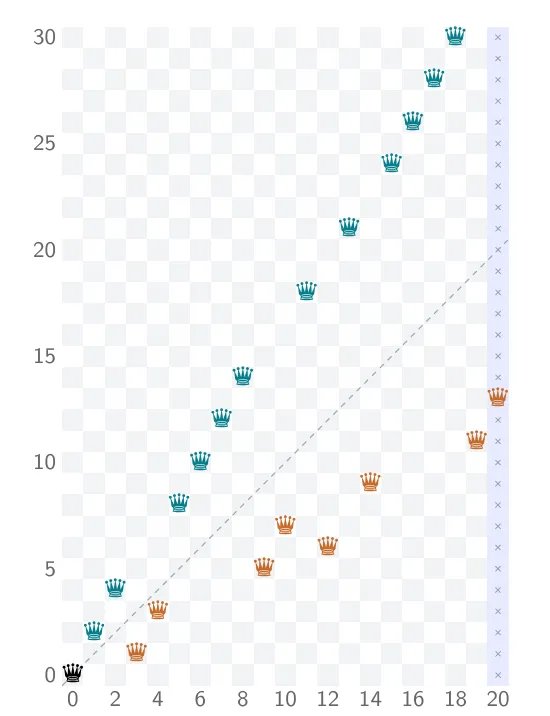
The first 20 columns. Teal queens sit above the main diagonal, orange ones below. — Figure 1, Ho (2026), arXiv:2609.31336.
Two lines and a famous number
Plot the queens over the first hundred columns and they fall onto two straight lines. The queens above the diagonal climb with a slope close to 1.618; those below, with a slope close to 0.618. Both numbers are tied to the golden ratio, φ = (1 + √5)/2: one line is y = xφ, the other y = x/φ.
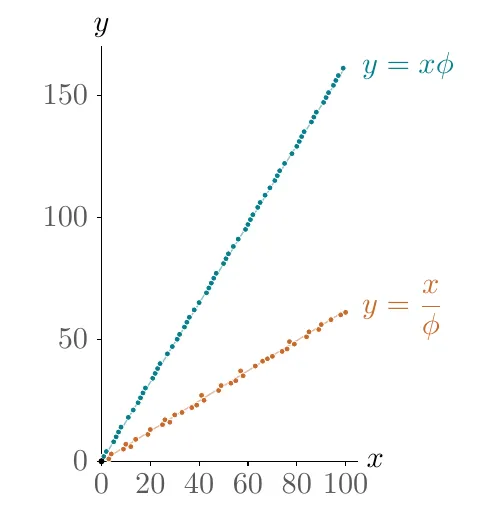
The queen positions for the first 100 columns, on equally scaled axes, with the lines y = xφ and y = x/φ. — Figure 2, Ho (2026), arXiv:2609.31336.
The sequence has been in the On-Line Encyclopedia of Integer Sequences since 2001. In 2020, Michel Dekking, Jeffrey Shallit and Neil Sloane conjectured that the queens never stray more than a bounded distance from these two lines. Donald Knuth checked it numerically up to a billion columns. Nobody had proved it.
The theorem
Boon Suan Ho, of the National University of Singapore, now proves it with explicit bounds. For every column n:
- a queen above the diagonal is less than 5/φ ≈ 3.09 squares from the line y = xφ;
- a queen below it is less than 4 + 5/φ ≈ 7.09 squares from the line y = x/φ.
Why the golden ratio? Suppose a fraction θ of the queens sit above the diagonal. Counting how the two families share rows and diagonals forces θ to satisfy θ² + θ = 1, whose positive solution is 1/φ. The real difficulty is to show that the error never grows. Everything comes down to one key lemma: the j-th queen below the diagonal always lies within 4 diagonals of the j-th lower diagonal.
A proof checked by machine
To prove that lemma, Ho describes the board before each column by a small “local state”: a few numbers plus short words in a four-letter alphabet recording where the high queens are. A finite “history graph” of 12-letter words (2,092 vertices, 2,603 edges) says which letters may follow which. A computer then explores every state reachable from column 30: 7,014 states, every one respecting the required bounds. An induction shows that the real sequence never leaves this finite set.
Two independent programs, sharing no code, reach the same states. A formalization in the Lean proof assistant accompanies the paper, and all the code is public.
Bonus: a game and a fast generator
The queens have a game hidden in them. Move a single queen left, down, or diagonally toward the left; whoever cannot move loses. The losing squares are exactly the greedy queens. Drop the anti-diagonal move and you get Wythoff’s Nim, a game already known to be ruled by the golden ratio.
The proof also yields a remarkably frugal algorithm. Ho’s program generated ten billion queens in about 25 seconds using 1.76 megabytes of memory, against 49 seconds and over 6 gigabytes for an adaptation of Knuth’s program. Each diagonal of the board, it turns out, holds exactly one queen.
Found with an AI
The paper ends with a declaration: “The proof was found with GPT-6 Pro, which also produced an initial draft of this paper.” It was later revised with Claude Opus 5.5 under the author’s direction. One question remains open: Knuth’s tighter lower bounds, confirmed by computer up to a hundred billion columns, still await a proof.