هنوز ترجمه نشده است: متن اصلی به انگلیسی.
THE HIDDEN PHYSICS OF PAINTBRUSHES
Many human-made objects follow simple rules of proportion: the paper cites nails, turbine blades, suspension-bridge cables and wings. Living things do too, from metabolic rates to the swimming speed of animals from larvae to blue whales. The paintbrush, despite being one of humanity’s oldest tools, had never been examined this way. Yet anyone can picture “a brush”: spindle-shaped, with a fine tip, and proportions that feel instantly familiar.
Raphaëlle Taub, Christophe Poulard and Frédéric Restagno at the Laboratoire de Physique des Solides (Université Paris-Saclay, CNRS), with Jérôme Crassous (Rennes and ESPCI Paris) and Thomas Salez (Bordeaux and École polytechnique), asked whether that familiar shape hides a physical rule.
Two hundred brushes on the bench
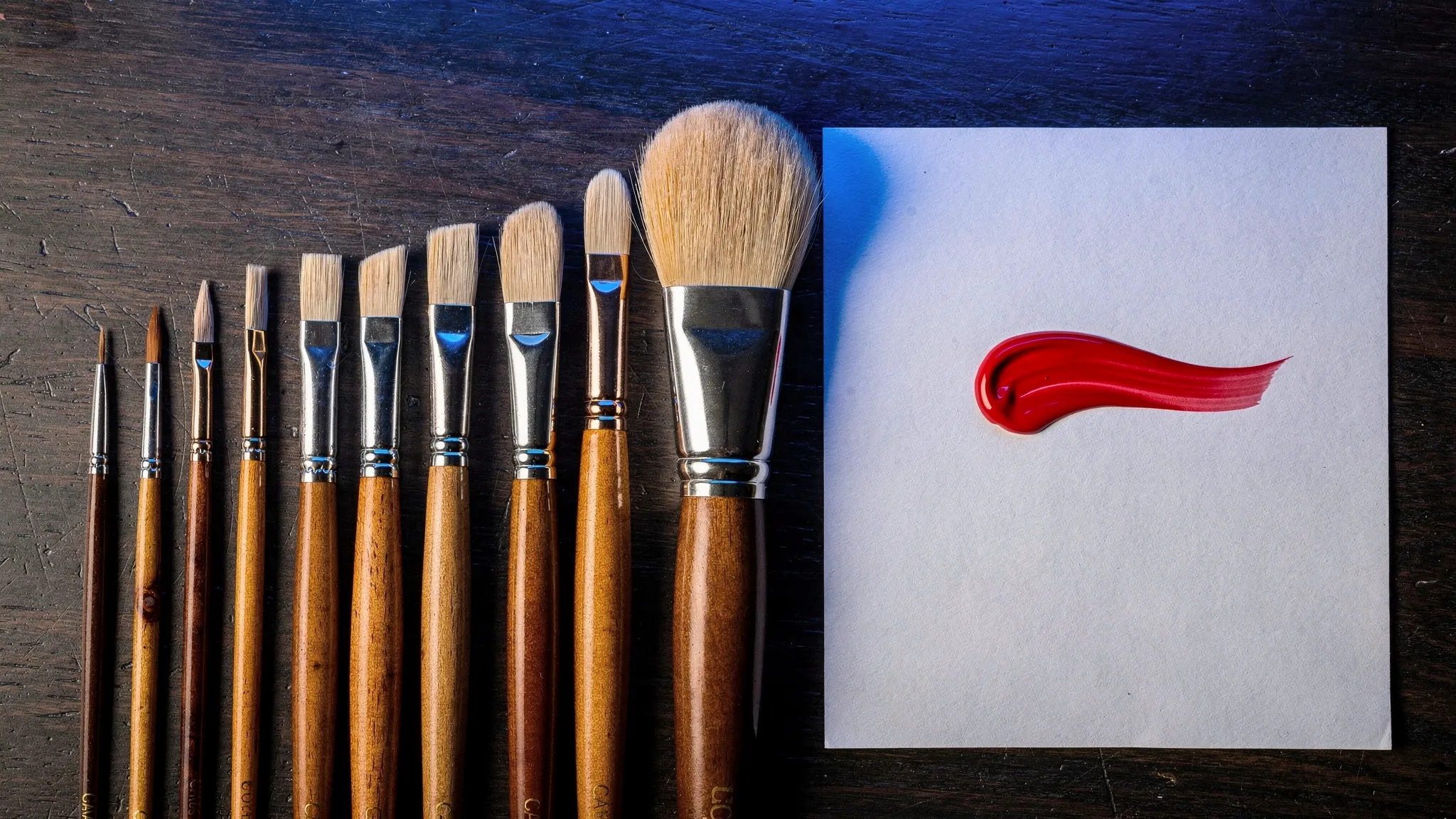
The team measured about 200 commercial brushes: fine-art, make-up, nail-art and construction brushes, synthetic, natural or mixed bristles, from many makers. Their ferrule diameters span two decades, from 0.4 to 40 millimetres. For each one they recorded the length L of the bristles and the diameter D at the ferrule.
The result is a clean power law, L ∼ D^β, whose exponent depends only on the shape of the tip, whatever the brush is meant for:
- rounded tip: β ≈ 0.62;
- conical tip: β ≈ 0.54;
- flat tip: β ≈ 0.90.
Big brushes are therefore not simply enlarged copies of small ones. Their proportions change with size, and in a way set by the tip.
Same push, whatever the size
The researchers then pressed dry brushes against a sheet of office paper on an aluminium plate, with a traction machine, and recorded the force as the bristles bent. The curves show three phases: the fibres bend elastically, then slide with friction on a plateau, then pile up as the brush is fully squashed.
In the first, elastic phase, the stiffness was about 203 newtons per metre when loading and 27 when unloading — with a lot of scatter, but no clear dependence on brush size. The counter-test is striking: when the team cut the bristles of a single brush shorter step by step, its stiffness changed strongly. So it is the combination of length and width chosen by manufacturers that keeps the stiffness constant.
Why the tip matters
A simple contact model explains the exponents. The tip decides how many bristles touch the paper as the brush sinks in: a flat tip engages many fibres at once, a rounded one a growing patch, a conical one long, poorly supported fibres. Describing the tip by an exponent α (1 for a cone, 2 for a rounded tip, infinite for a flat one), the total force becomes independent of brush size only if
β = α / (α + 1),
which predicts 1/2, 2/3 and 1 — close to the measured 0.54, 0.62 and 0.90.
What it means for the stroke
With gouache diluted in water, the brushes kept the same stiffness; the paint only smoothed small stick-slip jumps. For round brushes pressed at 43 degrees, the area of the paint mark grew linearly with how far the brush was pressed, regardless of the brush. Since force equals stiffness times compression, and stiffness hardly changes, a painter — or a painting robot — can control the size of a mark by force alone, with any round brush in hand.
The authors read this as an object shaped over history by its users rather than by explicit design rules, “in a Darwinian-like fashion”. The finding so far concerns round brushes; they suggest the same mix of measurement, mechanics and minimal modelling could be applied to make-up brushes and industrial coating tools.