Henüz çevrilmedi: İngilizce özgün metin.
MEASURING THE SUN WITH A CURTAIN ROD
Aristarchus of Samos (around 310–230 BC), a Greek astronomer and mathematician, was the first known thinker to propose that the Sun, not the Earth, sits at the centre. He also set out to measure how much farther the Sun is from us than the Moon.
A right angle in the sky
His geometric insight: at first or last quarter, when exactly half of the Moon is lit, the Sun, the Moon and the Earth form a triangle with a right angle at the Moon. Measure the angle δ between the Sun and the Moon as seen from Earth, and the ratio of the two distances follows: λ = sec(δ), that is 1 / cos δ.
Aristarchus found δ ≈ 87°, and so λ ≈ 19: the Sun would be about 19 times farther than the Moon. How he got 87° remains a mystery. One hypothesis suggests he estimated a one-day difference between the two halves of the lunar cycle.
The real value is about 400, which corresponds to an angle of δ ≈ 89° 51′.
The trap: close to 90°, a tiny error in the angle changes the result enormously. 87° gives 19; 89° gives about 57; 89° 51′ gives about 400. And the angle moves by about 30 arcminutes per hour, so two minutes of error on the time of the quarter already mean about one arcminute of error.
The instrument
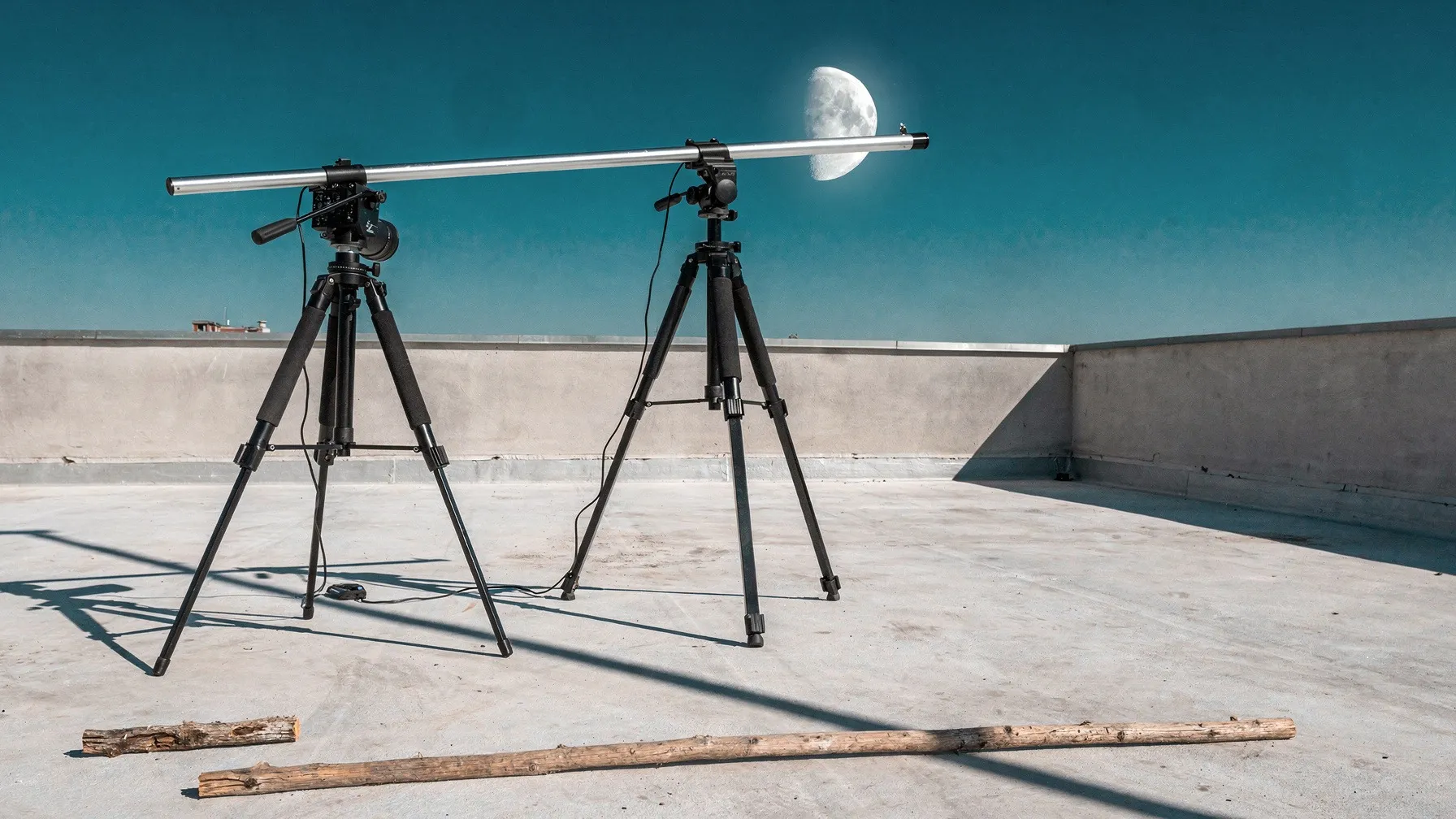
Hugo Caerols and colleagues at Adolfo Ibáñez University (Santiago, Chile) and Complutense University of Madrid built something anyone can copy:
- a 1.5 m curtain rod, 1.1 cm across, “just as we found it in the store”, on a camera tripod;
- you aim the rod at the Moon by looking through it, and the Sun casts its shadow on the ground;
- with a tape measure, you measure three lengths: from each end of the rod to the corresponding end of its shadow, and the length of the shadow. The law of cosines then gives δ.
The clever part: no need to aim at the Sun and the Moon at the same time, and no need to measure an angle directly — which is very hard to do to within one arcminute. The shadow moves fast, noticeably within about 30 seconds, so the team marked its ends with small wooden coffee stirrers.
A computer simulation of 1,000 measurements showed what to expect: 1 mm of measuring error gives about 5′ on the angle; 5 mm gives about 27′. Errors shrink when the Moon is high, and with a 2 m rod.
The real measurement
On 10 October 2024, at the Foster Observatory on San Cristóbal Hill in Santiago, the last quarter fell at 13:57. Clouds on the horizon delayed everything; the first usable measurements came after 15:00.
The team took 17 measurements between 15:00 and 16:30. Compared with the exact values from the Stellarium software, individual errors ranged from −32′ to +16′. A straight-line fit, extended back to the time of the quarter, gave δ = 89° 25′ ± 12′, and so λ ≈ 97.
That is still about four times less than the true value — a reminder of how sensitive the method is near 90°. But it is five times better than Aristarchus, with hardware-store equipment.
A first instrument, using laser pointers and a digital protractor to aim at the Sun and the Moon at once, was abandoned: too many alignment errors.
What limits the precision
- The main one: knowing the exact moment of the quarter. By eye, the line of shadow on the Moon barely changes over an hour, while the angle moves by half a degree.
- Centring a half-lit Moon in the rod, in daylight.
- Locating the end of the shadow when the Sun gets low.
- The tape-measure readings.
A classroom experiment, and a collective one
The authors propose simultaneous measurements in many places: 225 independent measurements accurate to 30′ would bring the average uncertainty down to 2′; with 10′ each, 25 would be enough. They list favourable dates for 2027 in Madrid and Santiago, and are developing a method based on photographs of the Moon to time the quarter precisely.
The activity scales from secondary school — building the instrument, geometry, trigonometry — to university: ephemerides, error propagation, regression and programming. Their simulation code is public.