अद्याप अनुवाद झालेला नाही: मूळ इंग्रजी आवृत्ती.
THE PAPER STACK THAT BOUNCES BACK
Drop a ball on a hard floor and it bounces. Slide a stack of paper underneath and it bounces less. That is what any cushion does: adding soft, energy-absorbing material between the ball and the ground should make the rebound worse and worse. A team at the University of Amsterdam has found that a stack of ordinary printer paper breaks this rule.
Physicists summarise a bounce with one number, the coefficient of restitution: the ratio of the ball’s speed after impact to its speed before. Predicting it from the properties of materials has resisted a century of effort, because many effects mix in it — deformation, friction, and waves that carry energy away. A wave is only lost, though, if it never comes back.
A ball, a camera, and up to 500 sheets
Manou Liesker, Colton Kawamura, Maria Kieft, Joshua Dijksman and Antoine Deblais held a 15-millimetre steel ball (13.71 grams) 20 centimetres above a stack of A4 sheets and released it without spin. A camera filming at 200 frames per second tracked its fall and rebound. They tried five paper weights, from 40 to 250 grams per square metre, and stacks from 1 to 500 sheets.
Down, up, then down again
With standard 80 g/m² paper, the restitution starts at 0.71 on the bare support and drops steeply to 0.50 with ten sheets — the expected cushion. Then the trend reverses. Over several tens of sheets the bounce climbs back, recovering four fifths of what was lost, to a broad maximum centred on 58 sheets. Beyond that, it falls again and levels off around 0.39.
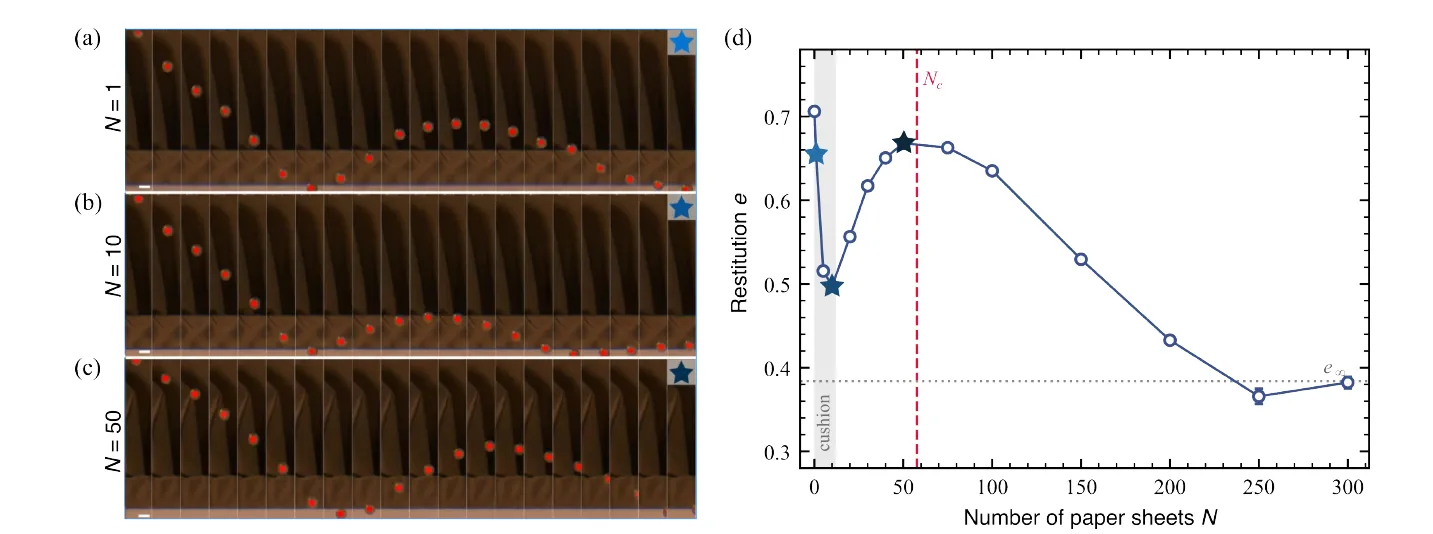
Left: the ball bouncing on 1, 10 and 50 sheets. Right: restitution versus number of sheets — a dip, a recovery peaking near 58 sheets, then a plateau. — Figure 1, Liesker et al. (2026), arXiv:2609.31213.
Every paper weight shows such a peak, from 18 to 100 sheets depending on the grade.
A sound wave that comes back in time
The impact launches a compression wave down the stack. It reflects off the rigid table and returns to the top. In paper, this wave is astonishingly slow: the team measured about 8 metres per second. A high-speed camera at 100,000 frames per second showed the ball touching the paper for about 3 milliseconds.
The bounce is best when the wave’s round trip matches the time the ball spends pressing into the stack. The echo then arrives just as the stack is most compressed and pushes the ball up while it leaves. With too few sheets, there is only a soft, lossy top layer. With too many, the ball is gone before the wave returns, and its energy stays trapped in the paper. Their formula predicts the peak at 55 sheets for 80 g/m² paper and 50 for 120 g/m² — against 58 and 55 measured.
It’s the air
Measured with a laser without touching it, each sheet of the stack takes up 114 micrometres, not the 100 of a single sheet: about 15 micrometres of air hide between neighbours. That air turns out to be decisive. In a vacuum box, at 100 sheets, the restitution falls from 0.66 to 0.29 as the pressure drops to 40 millibars. At 30 millibars, the peak vanishes entirely.
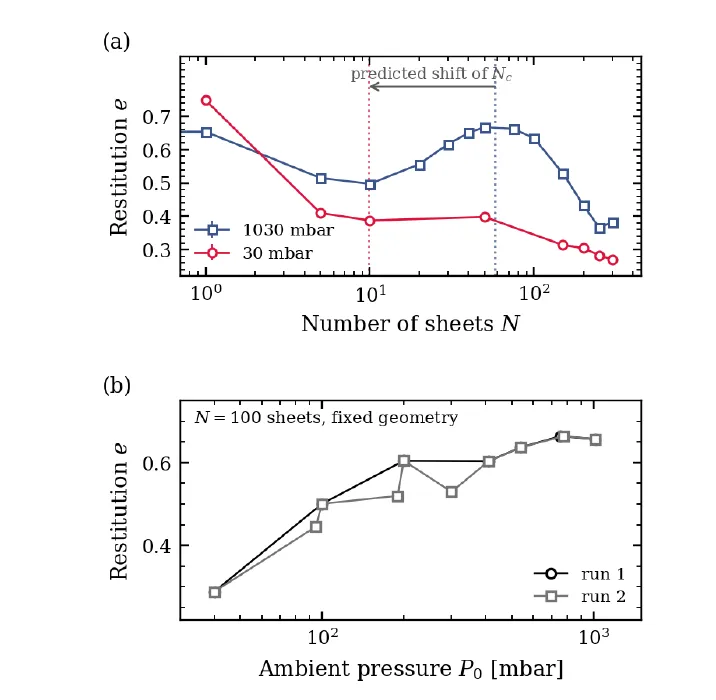
Top: with air (blue) the bounce recovers; at 30 millibars (red) it does not. Bottom: at 100 sheets, the bounce weakens as the air is pumped out. — Figure 3, Liesker et al. (2026), arXiv:2609.31213.
The air does not act as a sealed spring: that would make the stack four times stiffer than measured. It partly escapes sideways during the impact, storing and releasing energy as it goes. Proof: near the edge of the sheets, where air escapes easily, the ball bounces less. A simple chain-of-springs model puts the peak in the right place but recovers only a few percent of the bounce, against about 80% in the experiment.
Why steel never does this
For a steel plate, the same timing would require a quarter of a metre of steel. For any uniform solid ball, it would require impacts faster than sound. Soft, layered assemblies are the way to reach it at everyday speeds. The lesson, the authors write, is that a layered material’s bounce depends not only on how much energy it absorbs, but on when it gives back what it stored — something that could be designed into sports gear, packaging and protective layers by changing structure rather than material.