Перевод пока не готов: оригинал на английском.
HAUMEA HIDES A ROCKY HEART
Beyond Neptune orbit a few icy dwarf planets that were long seen as cold, dead worlds. Exploration has shown that some of them are active, and raised a tantalising question: could they hide — or have hidden — oceans of liquid water under their ice? Answering it requires seeing inside them, and direct measurements of their interiors are very rare.
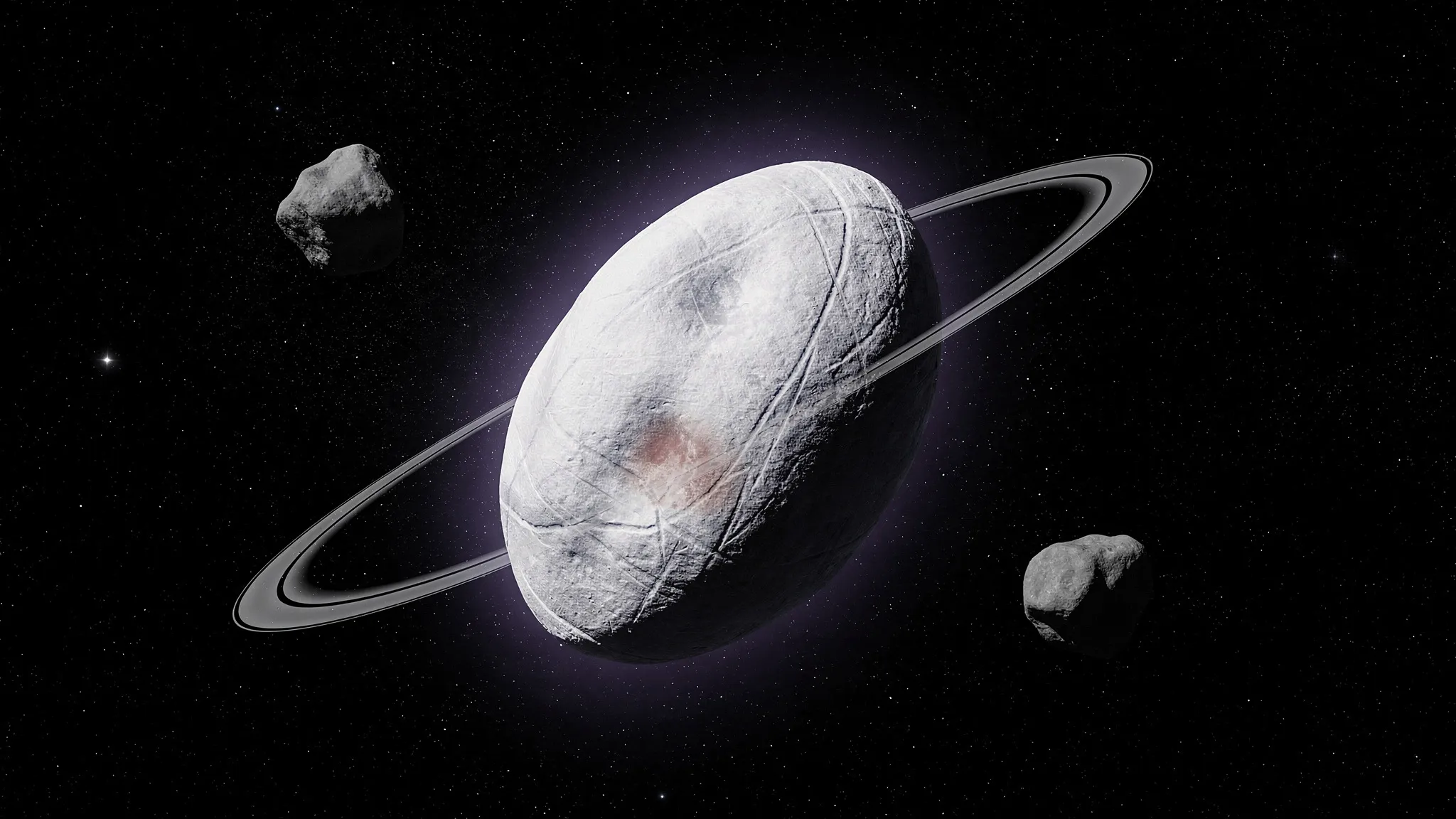
Haumea is the odd one of the family. It spins in about 3.9 hours, so fast that its shape is stretched into an elongated ellipsoid. Its surface is almost pure water ice. It has a ring, a family of fragments from an ancient collision, and two moons, Hi’iaka and Namaka. That makes it the best candidate to weigh what lies within.
Reading the inside through the moons
A spinning body is flattened, and that flattening shows up in its gravity as a term called J₂. J₂ makes the orbits of the moons slowly precess. Its value depends on how mass is distributed inside:
J₂ M R² = C − ½ (B + A)
where A, B and C are the body’s moments of inertia. Compare the J₂ measured from the moons with the outer shape, measured when Haumea passed in front of stars, and you learn whether the mass is spread evenly or concentrated at the centre.
Benjamin Proudfoot, of the University of Central Florida, and colleagues combined about twenty years of Hubble images of Hi’iaka and Namaka — including three new observations in 2026 — with a 2025 stellar occultation that caught both Haumea and Namaka. They fitted a dynamical model with 18 free parameters. A check: the orbital plane they derive matches that of Haumea’s ring, measured independently.
Too little flattening for a uniform world
The fit gives Haumea a mass of about 3.9 × 10²¹ kg and, for the first time precisely, J₂ = 0.143 (± 0.025). A uniform Haumea of the same shape would have a J₂ between about 0.22 and 0.26. Taking the shape, the mass and the rotation together, the uniform model is rejected at more than 3 sigma.
So Haumea is differentiated: a dense, rocky core under an ice-rich mantle. The authors call it the first conclusive dynamical confirmation of differentiation in a large trans-Neptunian object.
All the two-layer models that fit both the shape and J₂ have a core density between 2,500 and 3,500 kg per cubic metre. One example: a core about 800 by 690 by 450 kilometres, inside a body about 1,000 by 840 by 525 kilometres. Many other models work too.
A wet past
That density matches hydrated rock — rock altered by water. Such reactions only proceed above about 273 kelvin, so a large amount of water must, at some point, have been liquid inside Haumea, possibly as a subsurface ocean. Thermal models cited by the authors suggest the ocean could not have survived to the present day; they think this deserves a closer look. The core itself would still be hot today, above 700 K.
One puzzle remains. Makemake, comparable in size to Haumea, and Eris show methane on their surfaces that may come from such rock-water chemistry. Haumea shows none. Among the explanations discussed: a thin veneer of ice from destroyed moons covering it, or methane that never reached the surface.
The data also hint, without proof, that Haumea’s shape could be a “fossil”, frozen when it spun faster. Better occultations — one campaign targeted May 2026 — and more tracking of the moons should settle it. Meanwhile the team draws a bolder lesson: most worlds beyond Neptune larger than 1,000 kilometres probably melted inside and held liquids too.