अभी अनुवाद नहीं हुआ है: मूल अंग्रेज़ी संस्करण।
A GALAXY WITH NO STARS?
Our standard picture of the universe says that dark matter came first. Invisible clumps of it — called halos — formed, gas fell into them, cooled down and lit up as stars. But the smallest halos should not all have made it. Before the universe was reionized, their gas cooled too slowly; afterwards, it was kept warm by the ultraviolet light that fills the cosmos. Such halos would keep their original gas forever and never form a single star.
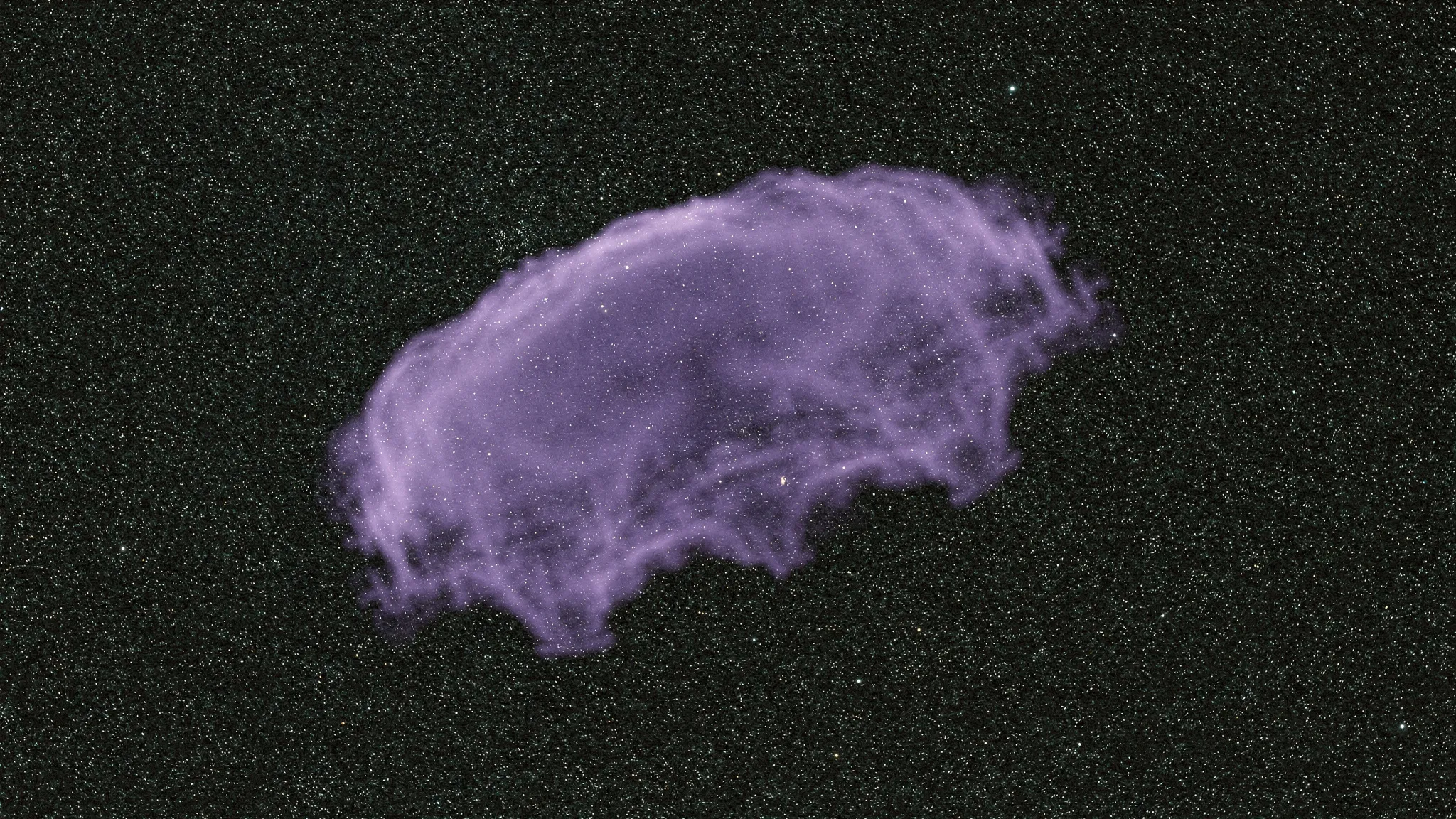
Astronomers call them RELHICs — Reionization-Limited H i Clouds — or simply “dark galaxies”. They are a firm prediction of the theory. They are also very hard to find: with no stars, they are invisible to ordinary telescopes. The only way to spot them is through the faint radio glow of neutral hydrogen at a wavelength of 21 centimetres.
A lonely cloud
A team led by Jin-Long Xu (National Astronomical Observatories, Chinese Academy of Sciences) and Alejandro Benítez-Llambay (University of Milano-Bicocca) found one in a blind radio survey made with FAST, China’s 500-metre radio telescope. They observed it three more times in July and August 2026. Repeated observations on different dates ruled out radio interference. The cloud does not appear in existing catalogues of dark-galaxy candidates.
They named it J1351+0039. It lies about 3.7 megaparsecs away — roughly 12 million light-years. No large galaxy sits within 100,000 parsecs of it. There are no tails or bridges of gas that would betray material torn from a neighbour.
What the numbers say
- Neutral hydrogen: about 480,000 times the mass of the Sun; around 640,000 once helium is counted.
- Size: an effective radius of 2.9 kiloparsecs, and an almost round shape (axis ratio 0.94).
- Stars: none detected in deep images from the DESI Legacy Survey. At most 150,000 solar masses of stars could be hiding below the detection limit.
- Total mass, measured from how fast the gas moves: about 130 million solar masses.
That gives a ratio of about 200 between the dark matter and the ordinary matter. Without that invisible mass, the authors calculate, the cloud would disperse within about 240 million years.
The gas barely rotates — about 4 km/s — while its internal random motions reach about 11.6 km/s. So the cloud is held up by pressure, like a ball of warm gas, not spinning like a disc. Its temperature, about 11,000 K, matches gas kept warm by the cosmic ultraviolet background: it has never cooled enough to make stars.
What is still uncertain
The authors are careful. A very diffuse population of stars, like that of the ultra-faint dwarf galaxy Leo T, would still be invisible in the current images at this distance. Deeper images from space, with Hubble or the James Webb Space Telescope, are needed to confirm that the cloud is truly starless. The weak rotation is also unexpected for a RELHIC; the authors suggest the cloud may have slowly picked up some spin.
So J1351+0039 is a candidate: either a genuine dark galaxy, or an extremely faint ordinary one.
The cleanest candidate yet
Earlier candidates — Cloud-9 near the galaxy M94, and two near M51 — sit close to large galaxies whose gravity could have shaped them. J1351+0039 is alone. According to the authors, that makes it the cleanest and most convincing isolated dark-galaxy candidate found so far: a natural laboratory to study dark matter and gas where no star has ever formed.