Henüz çevrilmedi: İngilizce özgün metin.
CELLS THAT DIVIDE KEEP THE SWIRLS PERFECT
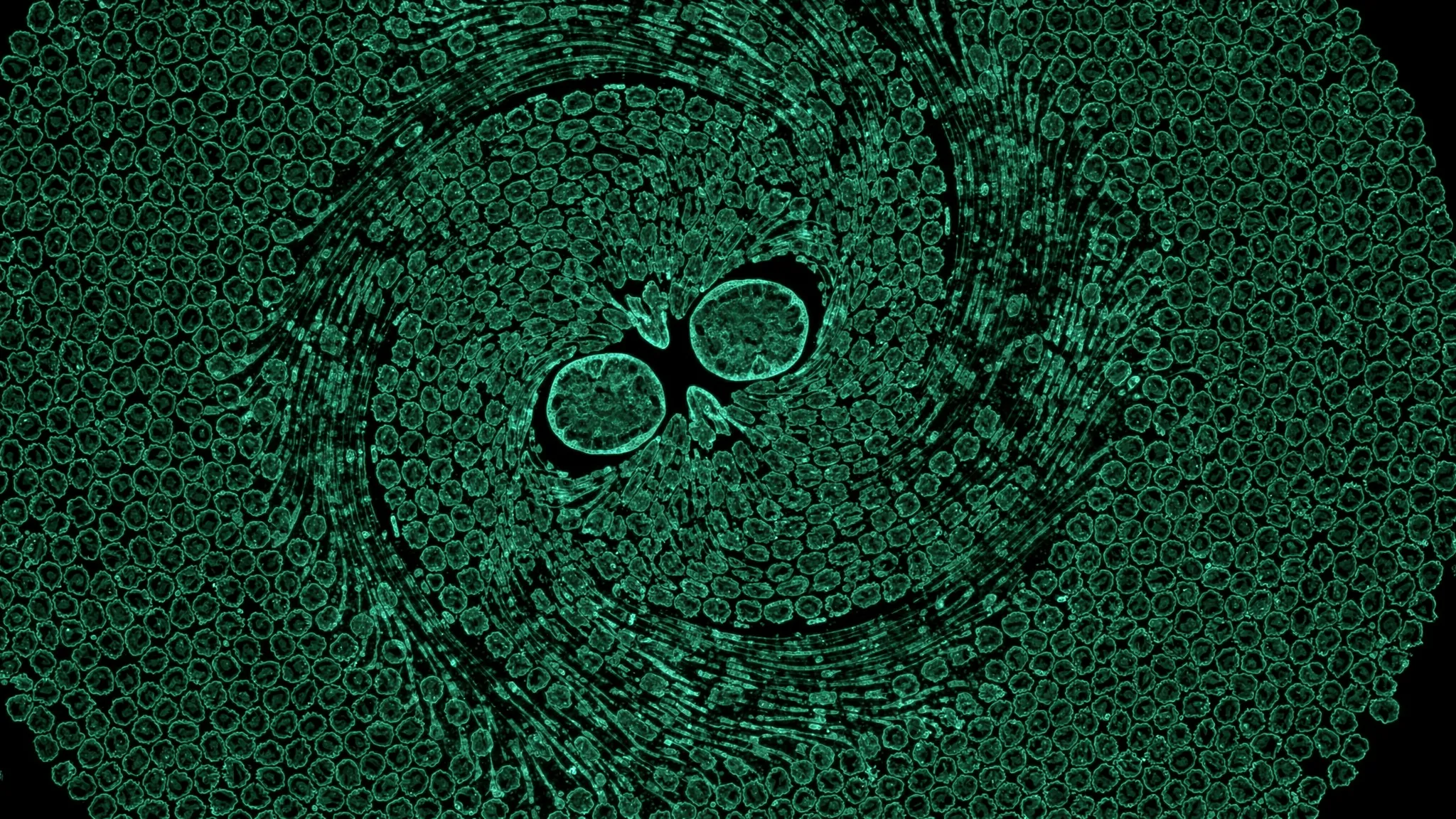
Cells in a sheet of tissue — an epithelium — rarely stay still. They crawl together in jets and vortices. These collective flows matter for wound healing, for the shaping of tissues and organs, and for the spread of cancers.
A surprising pattern hides in these flows. Draw the lines that separate regions turning clockwise from regions turning anticlockwise. In earlier work, published in Nature Physics in 2025, physicists found that in cell sheets and in bacterial colonies, these lines obey conformal invariance: their statistics stay the same when you shift them, rotate them or zoom in or out. They even match a precise class of mathematical shapes known from physics, that of critical percolation.
That is strange for living matter, which constantly burns energy and is far from equilibrium. Tianxiang Ma, Amin Doostmohammadi and colleagues at the Niels Bohr Institute in Copenhagen, with a co-author in Lisbon, asked what keeps this geometry in place — and what breaks it.
A single number for a shape
To test the geometry, the team used a tool called Schramm–Loewner evolution (SLE). It converts each wiggly line into a random process described by a single number, κ (kappa). For critical percolation, κ = 6. Two independent checks — the probability that a line passes to the left of a given point, and how fast a related quantity spreads — give an estimate of κ for each experiment.
They filmed confluent layers of MDCK cells, a standard line of dog kidney cells, and measured their motion under the microscope.
Stop division, lose the geometry
In untreated layers, the swirl boundaries matched the theory almost perfectly: κ = 6.002 ± 0.155.
The team then blocked cell division with mitomycin C, a drug that stops DNA copying. The cells still moved; jets and vortices persisted, with the same overall statistics. But the hidden geometry changed: κ rose to 8.18 ± 0.29, significantly different from 6. The lines also lost their scale invariance, becoming “multifractal” — their roughness now depended on how they were measured.
A second drug that prevents division by a different mechanism, nocodazole, which dismantles the cell’s internal scaffolding needed to split, produced the same breakdown.
As a control, they blocked cell death instead, using an inhibitor called Q-VD-OPh, while division continued normally. Every signature of the universal geometry survived. Division, not cell turnover in general, is what matters.
A tissue that can still shuffle
Why? With mitomycin, flows became slightly lopsided, which by itself breaks the rotational symmetry. But nocodazole did not cause that, so the authors looked for a more general explanation and found it in neighbour exchanges: with either drug, cells swapped neighbours much less often, and the tissue relaxed more slowly. It kept moving, but its network of cell contacts had become over-constrained.
A computer model of the tissue, in which cells are polygons and the share of dividing cells can be dialled from 0 to 100%, reproduced the whole story:
- with all cells dividing, the swirl boundaries matched κ = 6;
- below about 50% of cells dividing, the geometry broke down;
- more divisions made the simulated tissue softer, with lower stiffness and a lower energy cost for cells to swap places;
- removing cells without division did not restore the pattern.
Renewal as a physical role
The authors conclude that divisions act as intermittent “topological renewals” that keep the cell network flexible enough to rearrange across scales. Beyond its role in growth, cell division would thus be a structural and mechanical regulator of how tissues organise themselves.
They add that drugs which stop cell proliferation, used against cancer and in cardiovascular medicine, could have unexpected effects on how tissues move — a suggestion that this study, done on cultured dog cells and simulations, does not test directly. The work was published in the Proceedings of the National Academy of Sciences, according to the reference given by the authors on arXiv.