Henüz çevrilmedi: İngilizce özgün metin.
ONE RNA MOLECULE TO START IT ALL?
Every living cell turns genetic information into proteins with the same machine: the ribosome. It works with more than 100 transfer RNAs and several enzymes that load them with amino acids. How could such an interlocked system ever appear? The ribosome needs proteins to work efficiently — but proteins need the ribosome to be made.
The classic scenarios each run into a version of this puzzle. In the “RNA world”, RNA came first; in the “protein world”, proteins did; in co-evolution models, both grew together. According to Alice Cleynen of the University of Montpellier and CNRS, and Archa Fox and Nikolay Shirokikh of the University of Western Australia, all of them leave a gap: they do not explain how useful features could be both produced and selected before genes and their effects were physically linked.
A single molecule doing two jobs
Their proposal is the riboreplisome: an ancient RNA molecule that both copied itself and carried the first steps of protein synthesis. Replication and translation, in this view, started as two functions of the same molecule. Ribosomal, transfer and messenger RNAs would all descend from it.
The authors lean on recent experiments. A polymerase ribozyme only 45 nucleotides long, evolved from random sequences, can make its complementary strand and a copy of itself, they note. Ribosomes whose two halves are tied into a single RNA chain still work. Fragments of about 67 nucleotides from the ribosome’s catalytic heart can form peptide bonds. And RNA has been shown to attach amino acids to itself in water, at neutral pH.
Twelve steps to a cell
The paper lays out a 12-step pathway:
- Steps 1–2, the only “non-Darwinian” ones: short RNAs join into a molecule that can copy; pairing then restricts copying to “self”. From here, natural selection runs without interruption.
- Step 3: the copier loads an amino acid onto its own end — the birth of the riboreplisome, now “a complete genetic system”.
- Steps 4–8: it specialises in certain amino acids, builds short peptides, duplicates itself; spare copies become proto-transfer RNAs, and a coding repertoire expands.
- Step 9: a movable segment acts like a messenger RNA.
- Steps 10–12: containment in a membrane or droplet keeps the products close; finally the proto-ribosome splits into its two subunits, and the original molecule becomes an RNA genome.
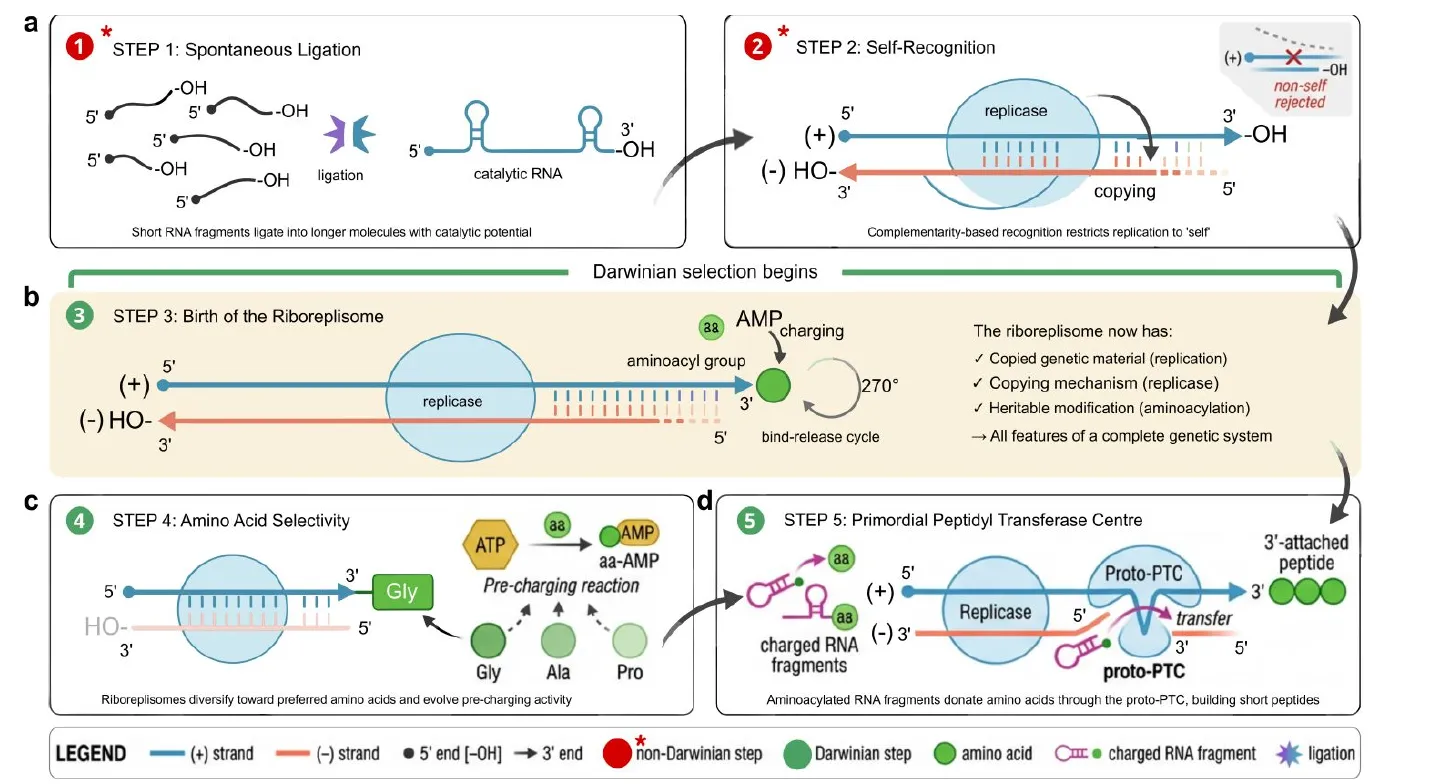
Steps 1 to 5 of the proposed pathway. Red asterisks mark the two non-Darwinian steps; Darwinian selection begins after step 2. — Figure 2, Cleynen, Fox & Shirokikh (2026), arXiv:2609.30816.
Three models, one conclusion
The authors compare their single molecule with an “RNA soup” in which separate molecules must cooperate.
- Fitness landscapes: with few interactions between steps, the landscape has about 11 local peaks; with the strong interdependence of a soup, about 155. Evolution gets trapped far more often in the soup.
- Information: of 165 bits of functional information, 65 (39%) must arise by chance in the first two steps. These two steps hold over 99.99% of the waiting time; the ten others follow quickly.
- Population simulations: over 500 generations, the riboreplisome’s fitness rises from 1.0 to 2.61, while the soup’s falls to 0.46 — a 5.69-fold gap. The main culprit is diffusion: useful products drift away from the genes that made them. Removing cheating molecules barely helps.
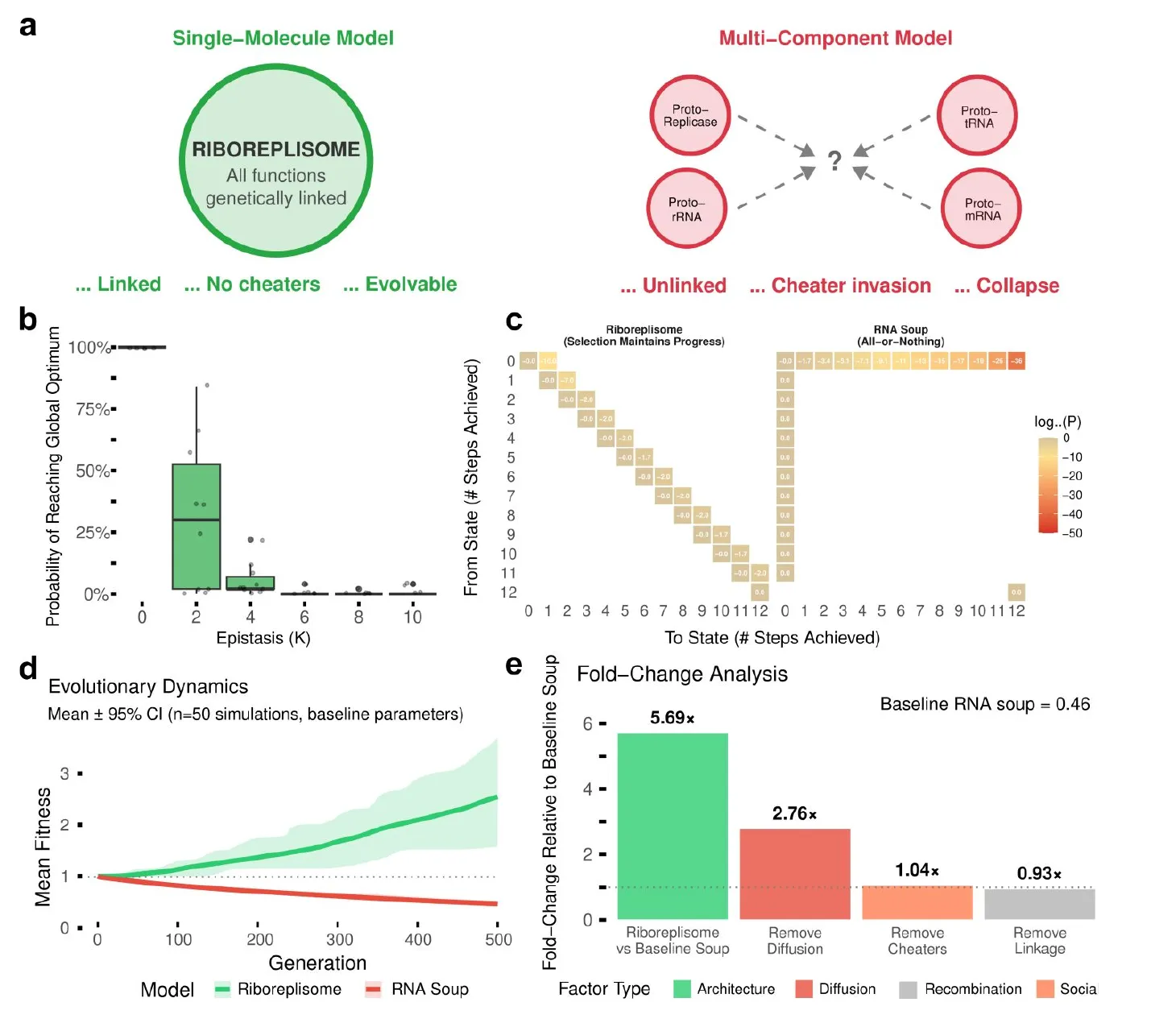
A single linked molecule versus a soup of cooperating RNAs: the riboreplisome’s fitness climbs while the soup’s declines; diffusion of products is the biggest handicap. — Figure 4, Cleynen, Fox & Shirokikh (2026), arXiv:2609.30816.
A theory waiting for its tests
This is a hypothesis, not a discovery: the paper reports no new experiment, and its models rest on estimated parameters. Some figures are inconsistent across the text — the probability of reaching the best solution is given as 5% in one place and about 30% in the figures, for instance. The authors offer four ways to test it: evolve minimal riboreplisomes in the lab, search ribosomal RNA for their traces, check that single-molecule translation resists cheaters, and rebuild the predicted intermediates. The original riboreplisome is probably lost, they write, but its relics may survive in the RNA of every cell.