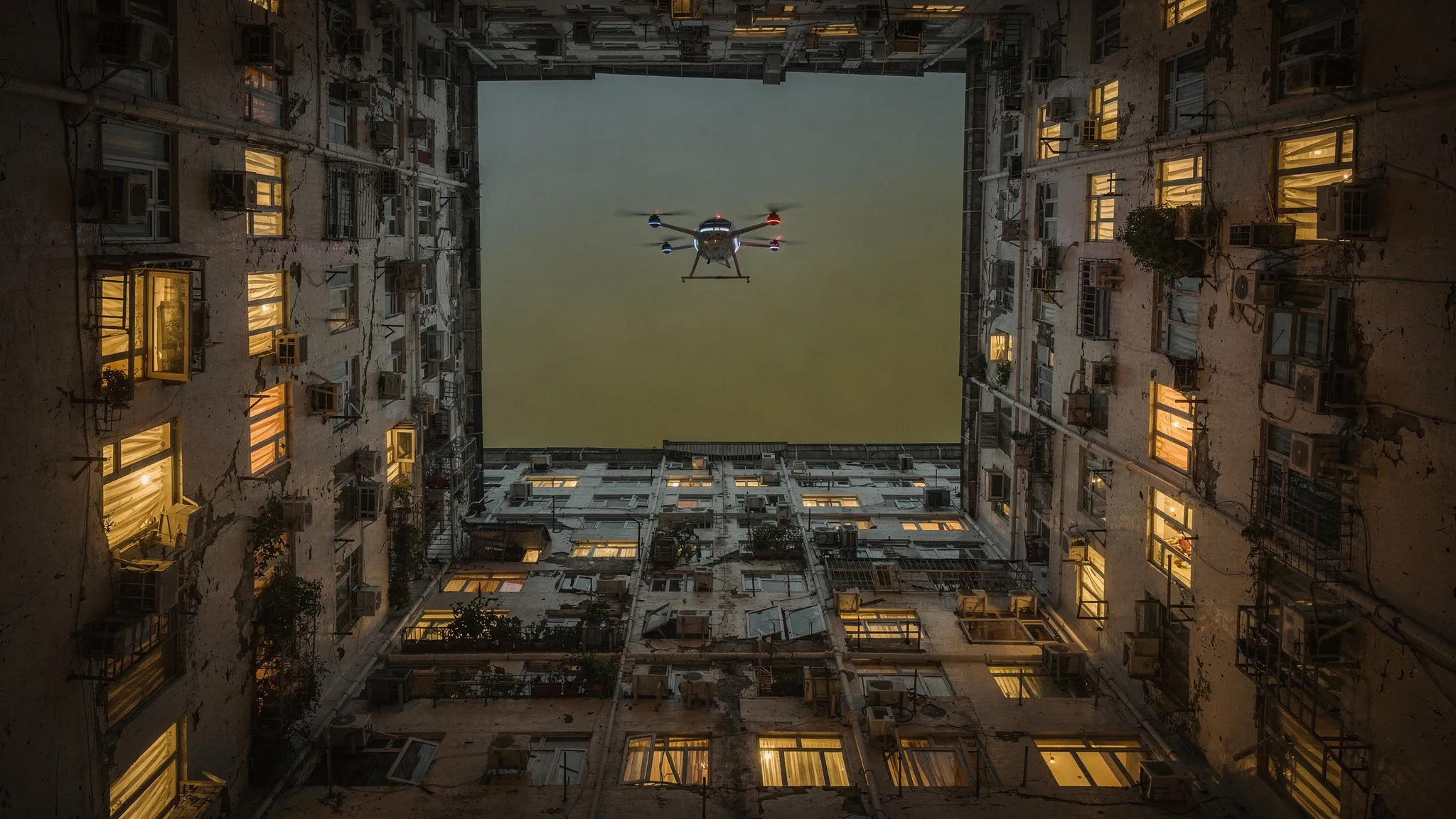
DELIVERY DRONES WILL CHANGE WHERE CITIES ARE LOUD
Low-altitude aviation is taking off around the world. NASA plans “Advanced Air Mobility” for passengers, cargo and public services; the European Union Aviation Safety Agency is working on urban air mobility; China has made the “low-altitude economy” a national policy, and similar efforts are under way in the United Kingdom, Japan and the United Arab Emirates. Two uses dominate: delivery drones and electric air taxis that take off vertically (eVTOLs).
Environmental noise is already a major urban health burden, linked to annoyance, poor sleep, and cardiovascular and metabolic effects. And current evidence suggests multirotor drones, with their tonal, high-pitched sound, annoy more than road traffic or airliners at the same sound level. Yet noise rules were designed for roads, railways and airports.
Ten cities, one identical route
Tianjing Feng and Jian Kang, of University College London, picked a central 2 × 2 km district in ten cities spanning all inhabited continents: Beijing, Dubai, Hong Kong, London, Nairobi, New York, Santiago, Shenzhen, Sydney and Tokyo. Their urban forms differ enormously, from Tokyo’s dense low-rise fabric (tallest buildings around 6 metres at the 90th percentile) to Shenzhen’s towers (99 metres).
Over each district, they simulated exactly the same flights: a straight corridor at 100 metres, flown by a delivery drone or a passenger eVTOL, at 25 or 150 aircraft per hour by day, half that in the evening, none at night. Buildings and terrain were modelled in 3D, along with each district’s existing road noise.
Where it hurts most: where it was quiet
- Directly under the route, with 150 air taxis per hour, noise reached about 65 decibels at ground level.
- Along busy roads, the added noise barely changed the total: traffic already dominates, with levels near 90 decibels in some districts. In Tokyo, the air taxis’ footprint covered 12.5% of the district, but only 0.36% became newly exposed above the reference threshold.
- The big changes happened in quiet, sheltered places: inner courtyards protected from traffic but open to the sky. In several courtyards of London and New York, noise rose by more than 20 decibels.
- Santiago had the largest share of newly exposed area (3.8%). In London, a noticeable increase (over 3 decibels) reached up to 315 metres from the route, and up to 360 metres in some cities, but only about 75 metres in Tokyo.
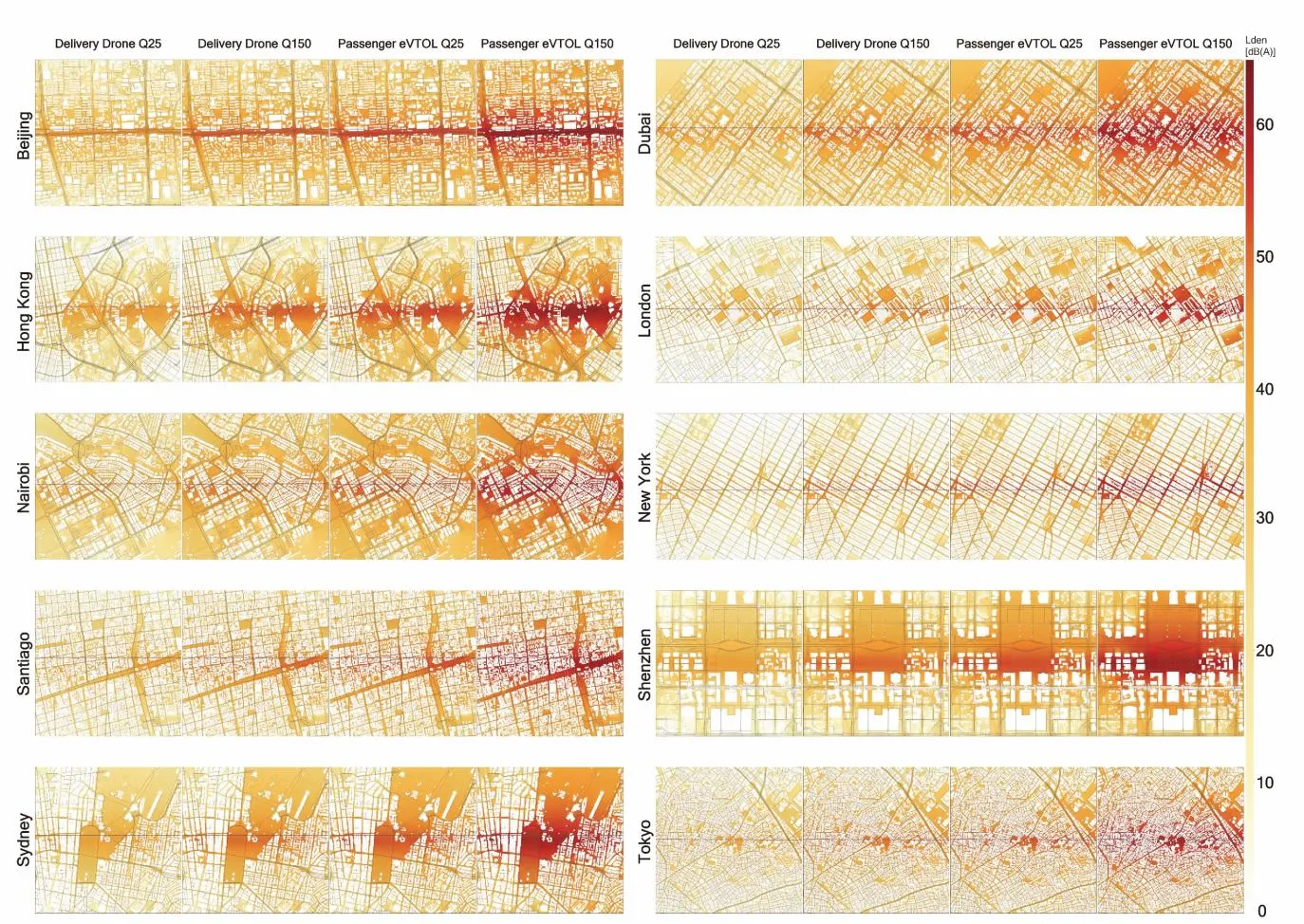
Noise from the aircraft alone at ground level in the ten districts, for the four drone and air-taxi scenarios. — Figure 2, Feng & Kang (2026), arXiv:2609.29763.
Louder upstairs
Road noise usually fades as you go up a building. This noise does the opposite: exposure climbs with the floors until it nears the flight altitude, then drops. A New York façade about 10 metres from the corridor reached nearly 70 decibels. Two sides of the same building could differ by several decibels; in hilly Hong Kong, the terrain brought whole buildings up to the level of the route.
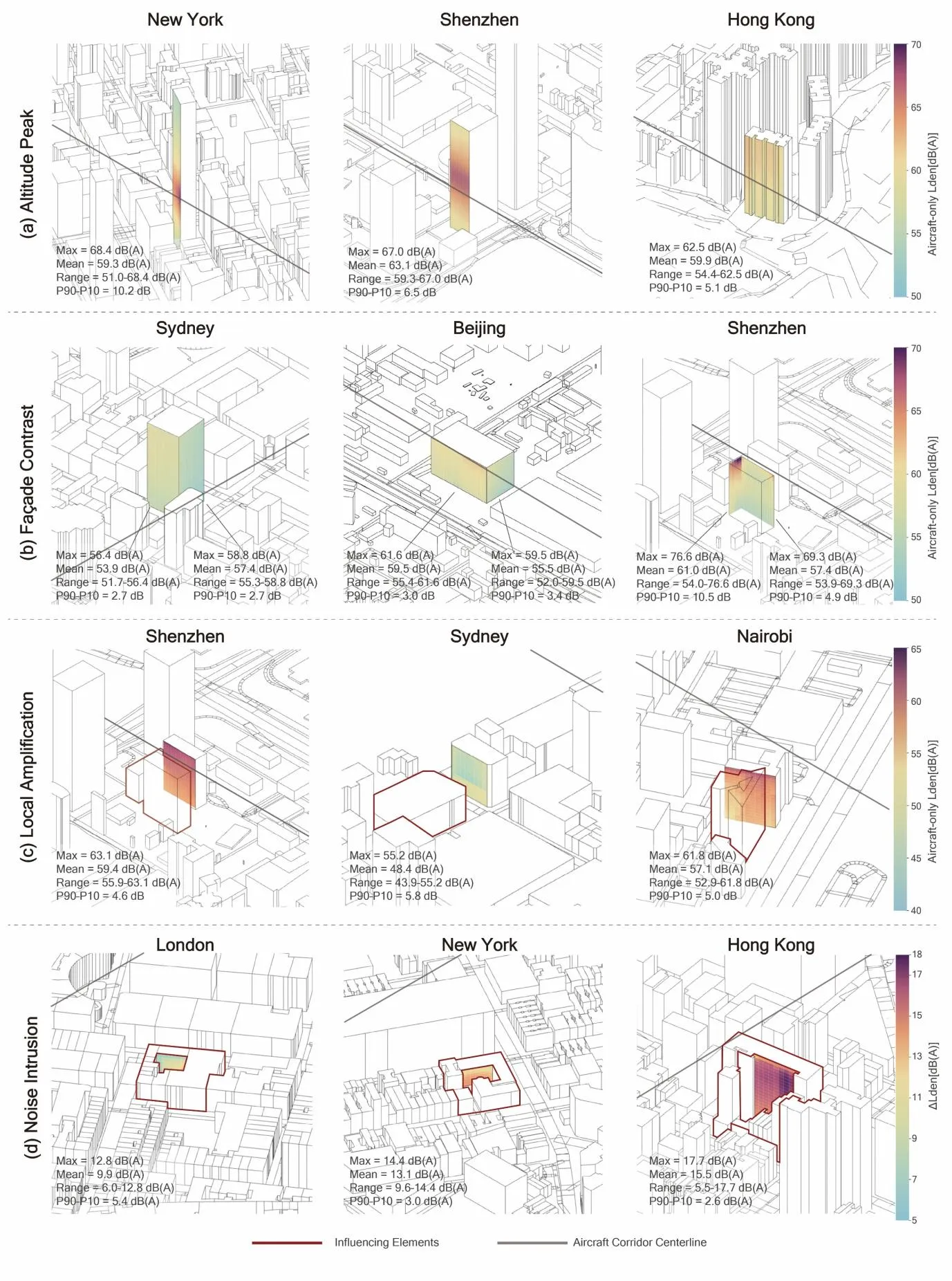
Four kinds of façade exposure: peak near flight height, contrast between façades, local amplification, and intrusion into sheltered courtyards. — Figure 5, Feng & Kang (2026), arXiv:2609.29763.
What the authors recommend
Noise assessment for flight routes should distinguish newly exposed areas from already noisy ones and should be done in three dimensions — façades and floors, not just a map at street level. Routing flights along busy roads is not enough, since nearby courtyards stay exposed from above. Absorbing materials, screens and roof shapes could help.
Limits
The simulations cover level flight at a constant 100 metres only — no take-off, landing or hovering — with assumed traffic levels and one district per city.