ابھی ترجمہ نہیں ہوا: اصل انگریزی متن۔
HOW EASILY DOES ANTIMATTER FORM?
Does antimatter fall like ordinary matter? Experiments at CERN’s antiproton decelerator, AD/ELENA, test the fundamental symmetries of physics with antihydrogen: one antiproton bound to one positron, the mirror image of the hydrogen atom. Among them, GBAR — “Gravitational Behaviour of Antimatter at Rest” — is built to measure how fast antihydrogen accelerates in Earth’s gravity.
GBAR’s route is unusual. Other experiments assemble antihydrogen by mixing antiprotons and positrons in a trap. GBAR instead plans two steps of charge exchange with positronium (Ps), an exotic atom made of an electron and a positron:
- p̄ + Ps → H̄ + e⁻: an antiproton grabs the positron and becomes antihydrogen;
- H̄ + Ps → H̄⁺ + e⁻: antihydrogen grabs a second positron and becomes a positive ion.
That ion can be cooled with beryllium ions, then a laser strips off the extra positron, leaving antihydrogen atoms at about 10 microkelvins — cold enough for a free-fall experiment.
Knowing the odds
The collaboration had already shown in 2023 that step 1 works with positronium in its ground state. But it could not say how likely the reaction is — a quantity physicists call the cross section, the effective target area an antiproton must hit. Without it, nobody can predict how many atoms the full experiment will produce.
The equivalent reaction with ordinary matter — a proton taking a positron to become hydrogen — had been measured only once, by Merrison and colleagues in 1997, between 11 and 16 kiloelectronvolts.
Two beams in a tiny cavity
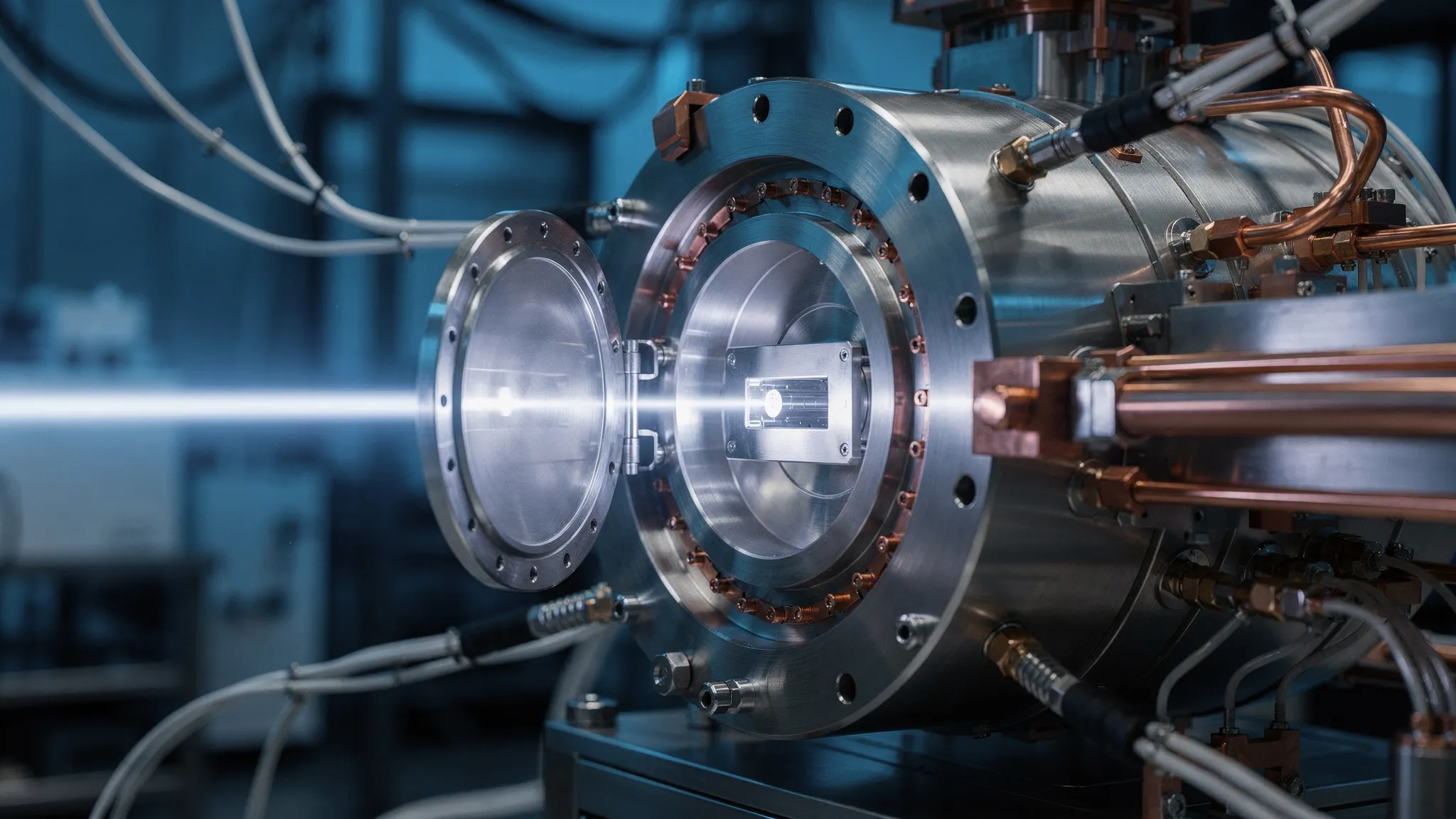
Since 2023, the team has improved its production rate tenfold. On one side, positrons from a small accelerator are piled up in traps: about 300 million between two antiproton shots, every two minutes. Roughly 100 million reach a cavity about 2 millimetres wide and 2 centimetres long, lined with porous silica that turns some of them into positronium. Each shot leaves a semi-confined cloud of about 6 million positronium atoms.
On the other side, ELENA delivers bunches of 12 million antiprotons. GBAR slows them down, traps them, cools them with electrons, then fires bunches of 5–6 million through the cavity at 4 or 6 kiloelectronvolts, timed to cross the positronium cloud. Any antihydrogen produced is electrically neutral: it flies straight on to a detector 1.6 metres downstream, while leftover antiprotons are deflected away.
Hundreds of antiatoms, one number
Comparing thousands of shots with and without positrons, the detector counted 379 ± 35 antihydrogen atoms at 6 keV and 69 ± 19 at 4 keV — about 392 and 71 after correcting for detector efficiency. Combined with careful counts of the antiprotons and positronium atoms involved, and of how well the two pulses overlapped in space and time, this gives the cross section:
- (14.1 ± 1.3) × 10⁻¹⁶ cm² at 6.2 keV;
- (8.7 ± 2.4) × 10⁻¹⁶ cm² at 4.15 keV (statistical uncertainties; systematic ones are listed separately in the paper).
It is the first measurement of a charge-exchange cross section made with antiproton beams, with smaller uncertainties than the 1997 measurement with ordinary matter.
Theory passes the test
Early calculations based on the so-called Born approximation disagreed with one another — unsurprising, the authors note, since the collision energy in the centre-of-mass frame is only about 6.5 electronvolts at 6 keV. Two modern methods solve the full quantum problem of three bodies: the Convergent Close Coupling method and the Faddeev–Merkuriev equations. They agree with each other, and, the team reports, show “excellent agreement” with the new data.
Next: the ion, then the fall
This is not yet a test of gravity. GBAR’s next step is to measure the second reaction, which builds the antihydrogen ion, starting with its ordinary-matter analogue using negative hydrogen ions from ELENA. Together, the two rates will fix how many ultra-cold atoms the experiment can drop — and therefore how precisely it will be able to tell whether antimatter falls like matter.