حالے ترجمہ نئیں ہویا: اصل انگریزی لکھت۔
WAS A SATURN MOON MADE FROM TITAN'S ICE?
Saturn’s system has two oddities. Iapetus, one of its large moons, is unusually rich in ice: compared with the big icy bodies of the outer Solar System — Quaoar, Pluto, Triton — it holds far more water than rock. Quaoar is smaller than Iapetus, yet much denser. And Titan, Saturn’s giant moon, follows an orbit that is more stretched than expected (an eccentricity of 0.029 today).
Titan orbits about 1.2 million kilometres from Saturn; Iapetus, about 3.6 million.
One impact, two puzzles?
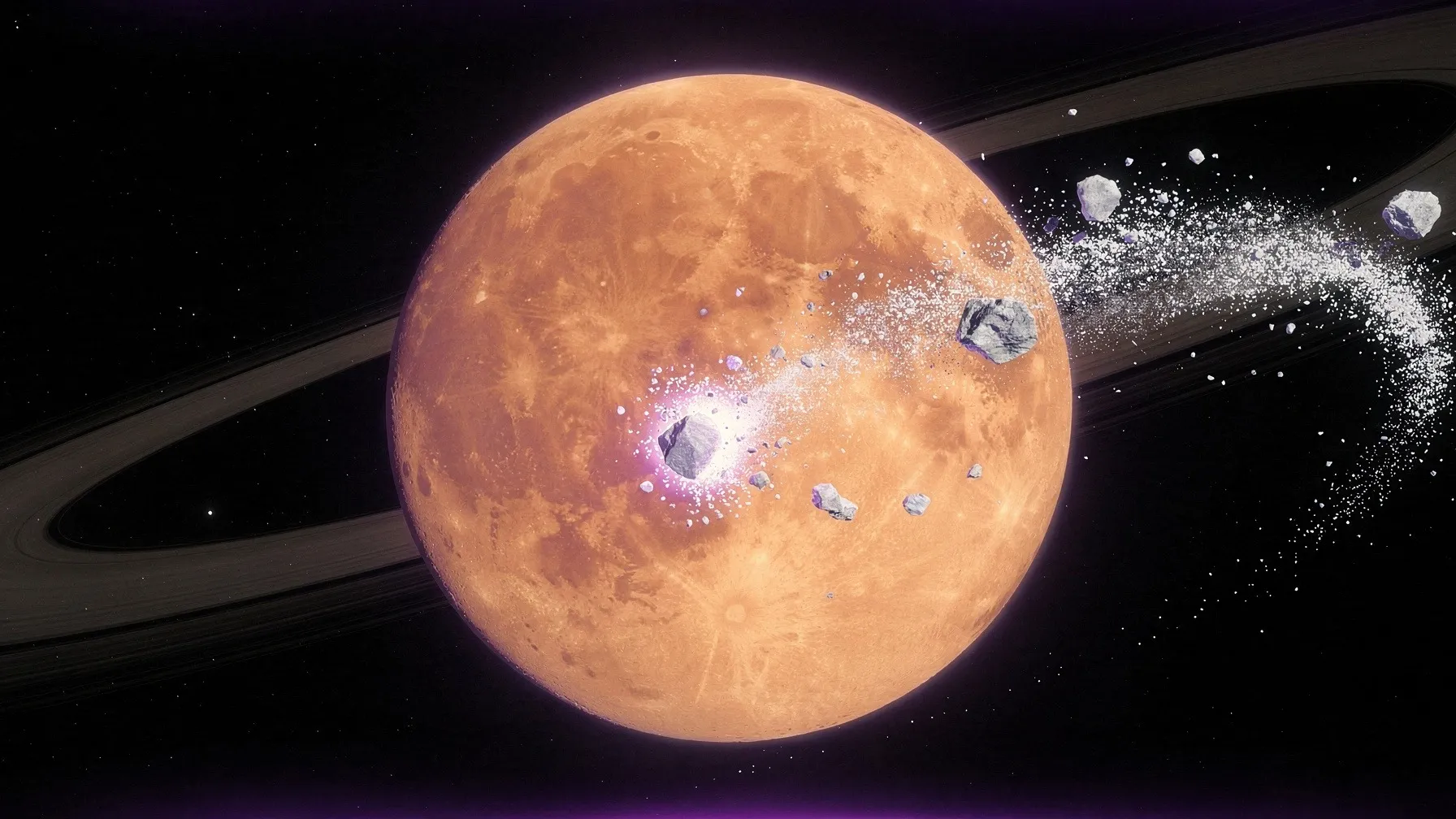
Ignacio Mosqueira of San José State University tests an idea he proposed with P. R. Estrada in 2005: a giant collision on Titan. The impact would have blasted ice from Titan’s outer mantle onto distant orbits around Saturn, where it could have gathered into Iapetus. The same blow would have stretched Titan’s orbit.
The scenario borrows from “hit-and-run” collisions, already invoked to explain Mercury’s oversized iron core: the rocky core of the impactor flies on, while ice stripped from the mantles stays behind.
What the simulations show
The study uses 3D impact simulations (with the Spheral code from Lawrence Livermore National Laboratory), including Saturn’s gravity, then follows the debris for days, years and up to 50 years. Both bodies have a rocky core and an icy mantle.
Scenario 1 — an impactor from outside Saturn’s system. A body with a tenth of Titan’s mass strikes obliquely at 10 km/s.
- About 3.5 Iapetus masses of debris remain bound to Saturn five days later, 83 % of it ice.
- 95 % of that ice comes from Titan’s mantle.
- One ice sample follows an orbit reaching beyond Iapetus’s distance.
- The impactor’s rocky core escapes Saturn for good.
- Titan’s orbital eccentricity jumps to about 0.13.
Scenario 2 — a companion already orbiting Saturn. A body a quarter of Titan’s mass hits at 45° and about 3.7 km/s.
- It releases 0.60 Iapetus masses of ice.
- Its rocky core skips past Titan, then — in one run — comes back and hits Titan 6.9 years later. After merging, Titan’s eccentricity would be about 0.10.
The limits, stated by the author
These are low-resolution “pilot” simulations — only about 27 particles per Iapetus mass. They do not resolve fragment sizes and are not shown to converge; the return dates are sensitive to numerical settings.
Above all, Iapetus does not form in the simulations. The ice ends up on highly elongated orbits that still cross Titan’s path. To settle into a circular orbit at Iapetus’s distance, it would need 67 to 86 % more angular momentum — something residual gas or a disc of debris might supply by slowing and rounding the orbits. That step is not modelled. Titan’s present eccentricity is also lower than the simulated values, so a later damping would be needed too.
What holds, what remains to show
The first step of the scenario holds: a collision can produce a reservoir of ice worth several Iapetus masses, mostly torn from Titan, while stretching Titan’s orbit. The rest — assembling Iapetus and circularising its orbit — remains to be demonstrated. The author also suggests a residual gas disc might explain other features of Saturn’s system, such as its icy inner moons and rings; these are ideas, not results.