Ba a fassara ba tukuna: ainihin rubutun Turanci.
A ZAP OF COLD PLASMA CLEANS SEEDS — AND RESHUFFLES THEIR FUNGI
Plant diseases cost crops dearly, and farmers rely heavily on pesticides and fungicides. These chemicals are effective but come at a price: poorer soils, less microbial diversity, resistant microbes, polluted water. Seeds are a major source of plant pathogens: each seed carries its own community of microorganisms — the seed microbiota — inside and on its surface. Some help the future plant grow and resist stress; others damage the seed or infect the next generation.
Hence the search for treatments that clean seeds without chemicals. Cold atmospheric plasma is one of them: air partly ionised by an electric discharge, full of energetic electrons, ions, reactive oxygen and nitrogen species and light. Only the electrons are “hot”, so the gas stays close to room temperature. Its microbe-killing power is well known. What it does to the fungi that later live with the young plant was much less clear.
Electrified air, two electrodes
Léna Taras, Christophe Bailly, Thierry Dufour and colleagues at Sorbonne University, the CNRS, Inserm, the École polytechnique and the French National Museum of Natural History used seeds of the plant Arabidopsis thaliana. They took two varieties, Columbia and Landsberg, each from two separate harvests produced in their lab.
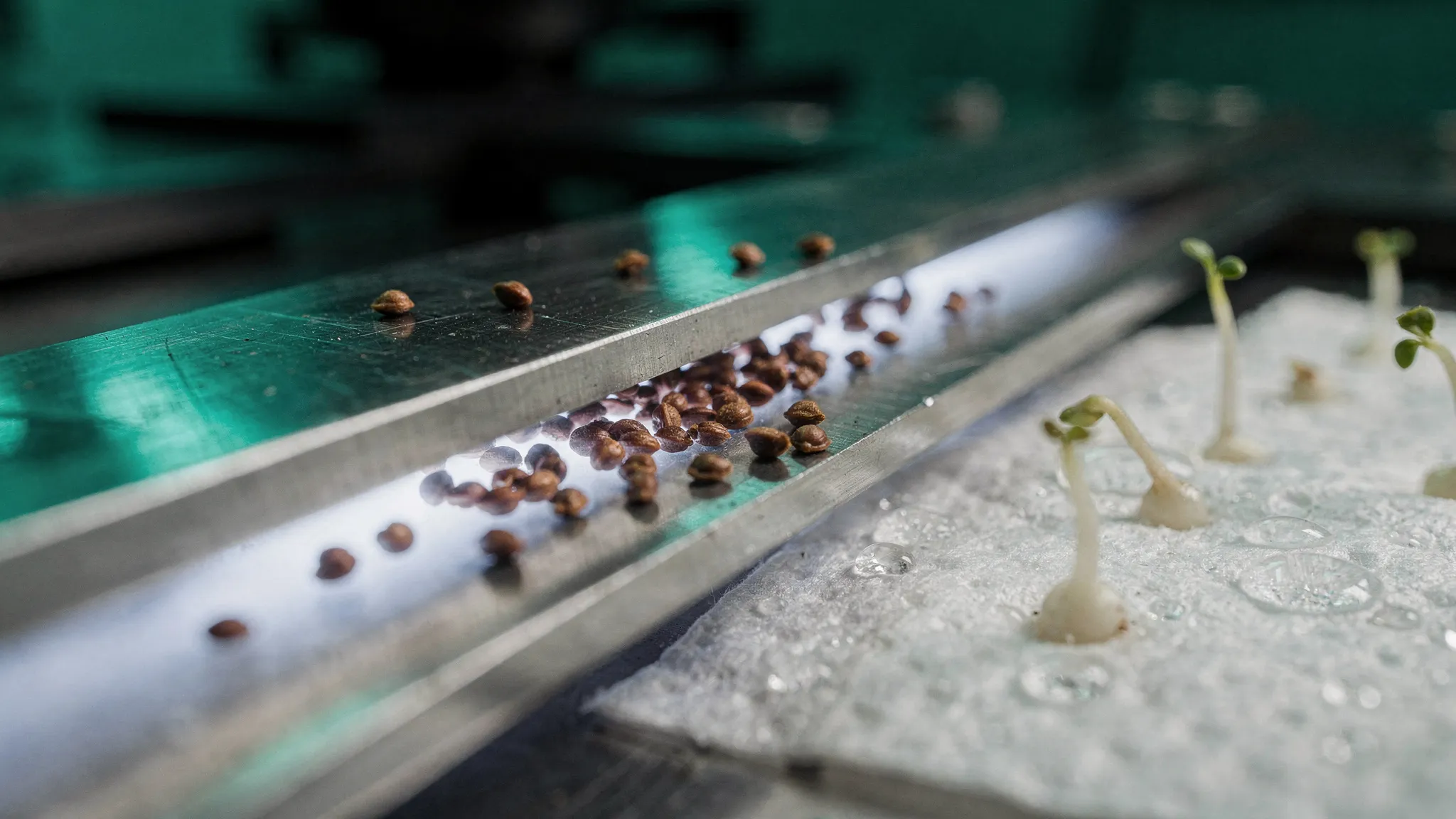
The dry seeds were placed between two flat electrodes, 30 by 40 centimetres, powered at 9 kilovolts and 140 hertz. The discharge turned the surrounding air into plasma for 5 or 15 minutes. The team then:
- put seeds on a nutrient gel and counted those around which mould grew;
- measured how cloudy a broth became as spores washed off the seeds grew;
- sequenced a fungal DNA barcode in seedlings grown in sterile conditions for about a week.
Mould gone, germination intact
Without treatment, 20 to 100% of the seeds developed visible mould, depending on the variety and harvest — most likely a Penicillium, judging by its brush-shaped spore structures. Five minutes of plasma almost entirely suppressed it. After fifteen minutes, no contamination was detected at all, even on the most heavily contaminated batch. In the broth test, spores from untreated seeds multiplied the cloudiness by 13 in 48 hours; after 15 minutes of plasma, it did not rise.
And the seeds did not suffer: all batches still reached 100% germination within three days, at the same speed.
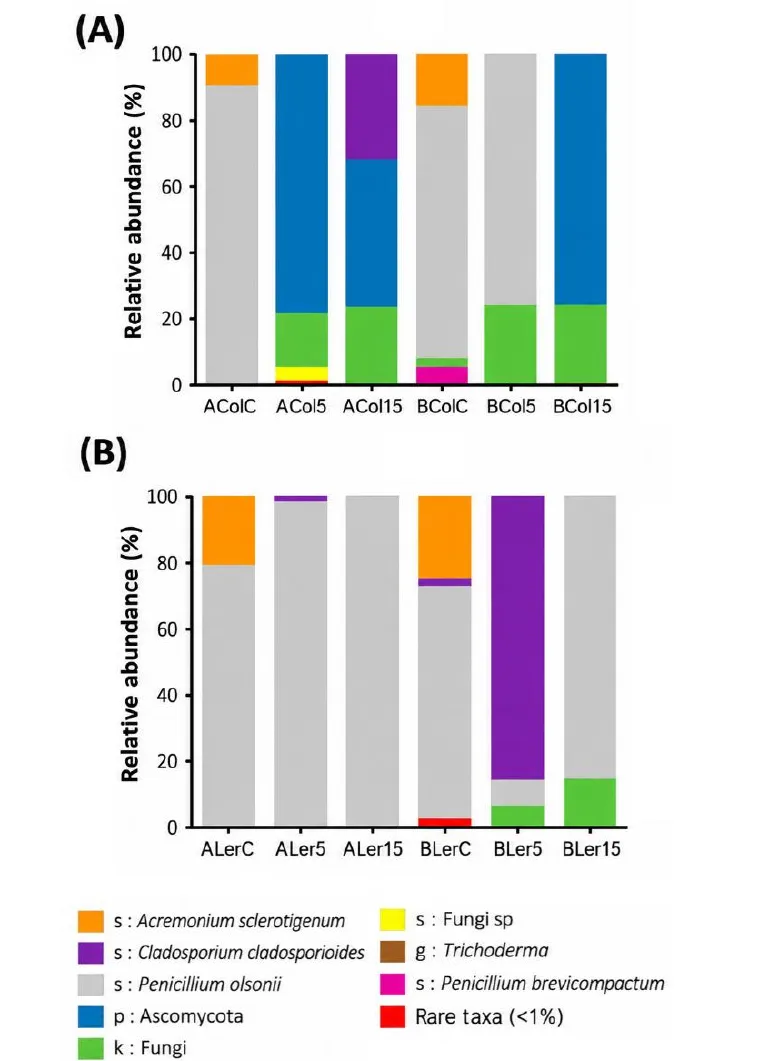
Fungi detected in seedlings of the Columbia (A) and Landsberg (B) varieties, from untreated seeds (C) or seeds treated for 5 or 15 minutes, for two harvests (A and B). — Figure 3, Taras et al. (2026), Plants, arXiv:2609.37222.
A new fungal neighbourhood
The DNA told a more complex story. Three fungi dominated the seedlings: Penicillium olsonii, Acremonium sclerotigenum and Cladosporium cladosporioides.
In Columbia seedlings, plasma strongly reshaped the community. In one harvest, the two dominant fungi became undetectable or fell below 1%, while Cladosporium, initially under 1%, rose to about 30% after 15 minutes. In the other harvest, the same shift needed the longer treatment. In Landsberg seedlings, Penicillium often stayed dominant — the authors think its DNA came from dead fungi, since nothing grew from treated seeds — but Acremonium dropped below 1% in both harvests. Cladosporium looked the most resistant and opportunistic.
The authors are cautious about the statistics: overall effects of treatment were significant, but pairwise comparisons did not survive correction for multiple testing, and the effect depended strongly on the variety and the harvest.
Their conclusion goes beyond hygiene. By removing dominant fungi, plasma frees space that other microbes, including rare ones living inside the seed, may then fill. Treatments will have to be tuned to remove the unwanted microbes while sparing useful ones — and tested next on real crop seeds, on large naturally contaminated lots, with machines able to treat seeds at high throughput.
Peer-reviewed: published in the journal Plants (2026).