Ainda não traduzido: versão original em inglês.
SEEING THROUGH LEAD WITH LASER-MADE MUONS
The muon is a heavy cousin of the electron. Thanks to its much larger mass, it loses little energy when crossing matter, and can pass through huge thicknesses of rock or metal.
That is the basis of muography: taking “X-rays” of huge or dense objects with muons. It revealed a large void inside Khufu’s pyramid in 2017, and has been used to probe volcanoes such as Asama and Etna, mines, railway tunnels, glaciers and cargo containers.
The limit of sky muons
Until now, muography has relied only on cosmic muons, produced naturally when cosmic rays hit the atmosphere. Their flux is low — about one muon per square centimetre per second — so exposures are long. They come mostly from above, and nobody controls their energy or direction.
The alternative: make an artificial muon beam with a laser. “Laser wakefield acceleration” can drive electrons to about 10 GeV over a few centimetres of gas. When those electrons hit a solid target, they produce muons. Laser-made muons were confirmed for the first time in 2025, in Shanghai and at Berkeley’s BELLA laser — but only detected indirectly.
The experiment
The work was done at ELI-NP (Extreme Light Infrastructure – Nuclear Physics) in Măgurele, Romania, with its 10-petawatt laser arm: 230 joules delivered in 23 femtoseconds, at most one shot per minute. The campaign used 230 shots.
- A 60 mm gas target produced electrons of up to 8 GeV.
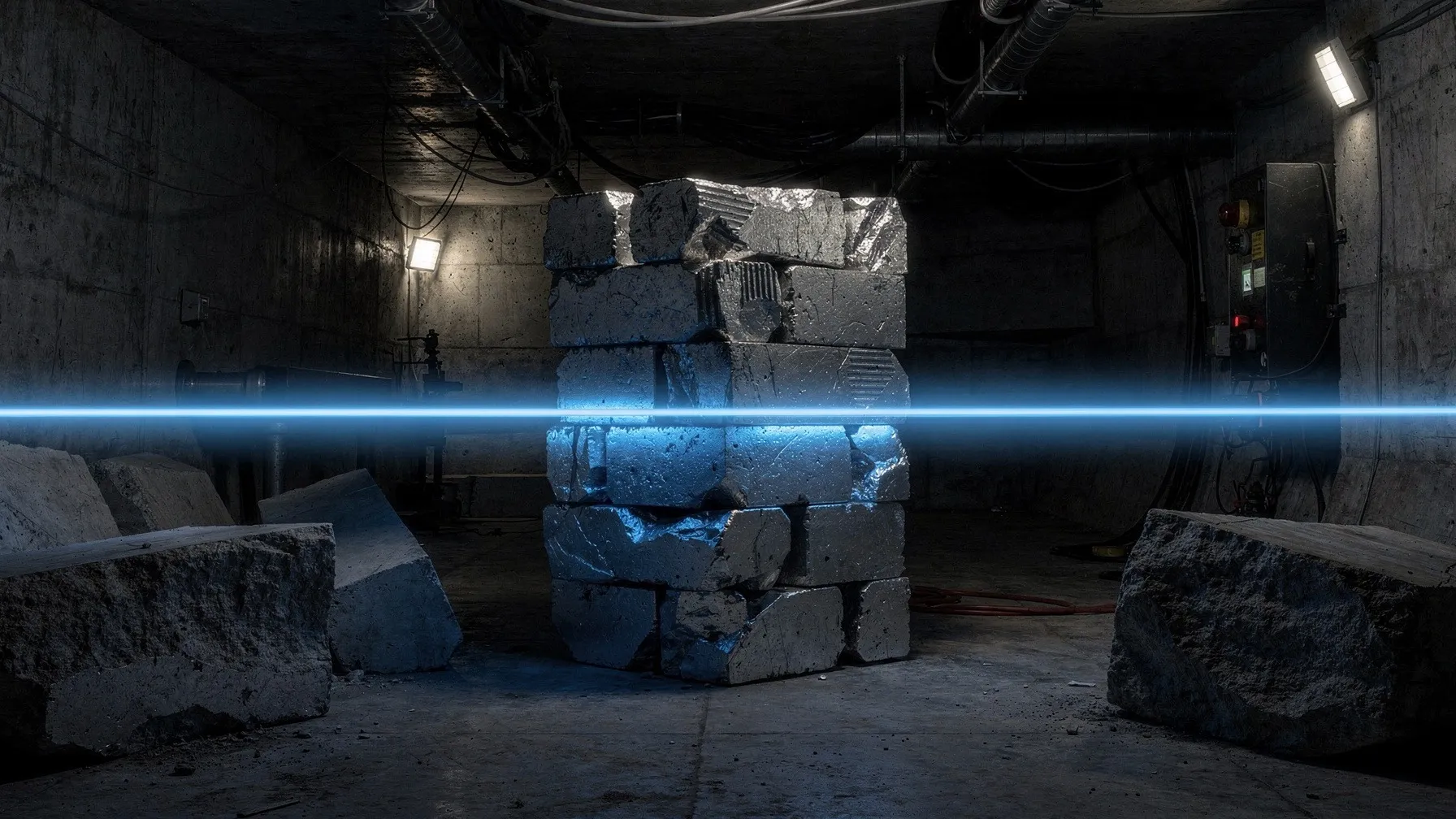
- They struck a 40 × 40 × 50 cm lead block. There, gamma rays created muon–antimuon pairs (the Bethe–Heitler process).
- Heavy shielding — 100 cm of polyethylene, 60 cm of paraffin, lead, and a 2-metre reinforced-concrete wall — stopped the unwanted neutrons and gamma rays.
- Three detectors built for muography recorded the beam. One of them, µ36, was mounted in a van and driven to 20, 29 and 42 metres from the source, and up to 6 metres to the side.
- Detailed Monte Carlo simulations (GEANT4) reproduced the whole setup, shot by shot, from the measured electron spectra.
What they measured
- Beam profile: a peak centred on the axis, 4.51 m wide (at half height) at 20 m and 6.35 m at 29 m — an opening angle of about 12.6°. The simulations give 4.43 m and 6.27 m.
- At 20 m, 86.9 % of the energy deposited in the detector comes from muons, even though unwanted particles are more numerous.
- Muon energy: a few GeV, up to 6–7. Muons need at least 1.5 GeV to reach the detectors.
- Image: a lead object of 20 × 25 × 100 cm, placed 23 m from the source, was imaged over 30 laser shots. Its reconstructed size: 22.5–25 cm — the real object is 25 cm thick. The signal behind it drops by about 26 %. Resolution: 2.5 cm, the width of one detector bar.
- In simulation, without the muons, the gamma rays and neutrons do not produce this image, only a flat background.
Beyond sky muons
According to the authors, this is the first imaging dominated by an artificial, laser-driven muon beam. An artificial source brings a stronger flux, and control of direction and energy — no more waiting on the sky. It could also serve muon spin spectroscopy and neutrino studies. The next campaigns aim for higher electron energies and detectors built for high fluxes.