अद्याप अनुवाद झालेला नाही: मूळ इंग्रजी आवृत्ती.
A DAM BREAKS IN A QUANTUM FLUID
A Bose–Einstein condensate is a gas of atoms cooled so close to absolute zero that they behave as a single quantum wave. It flows without friction, like a perfect fluid — with one extra ingredient: quantum pressure, which comes from the unavoidable jiggling of the atoms and makes waves of different lengths travel at different speeds. Physicists call such waves dispersive.
L. M. Farrell, D. H. J. O’Dell and colleagues at McMaster University in Canada, with co-authors in Heidelberg and Boston, studied the simplest violent event one can stage in such a fluid: a dam break. Atoms are held in a long, thin line, a barrier separates a denser region from a less dense one, and the barrier is suddenly removed. Their simulations use realistic numbers: 40,000 potassium-39 atoms, in which sound travels at about 1.8 millimetres per second.
Quantum tidal bores
With a small step in density — about 4% — two trains of ripples leave the site of the dam, one in each direction. Between them, a flat plateau forms, at a density exactly halfway between the two sides.
The team noticed that these ripples resemble the undular tidal bores that sometimes travel up rivers: a front followed by a train of waves. Adapting a simple model of river bores developed by the physicist Michael Berry, they derived formulas for the density and the flow that agree almost exactly with full numerical simulations of the condensate.
Two features stand out:
- the ripples form a cone in space and time, but an inside-out one: everything inside is calm, all the waves are outside;
- at long times, their shape becomes universal — the integral of an Airy function — and their wavelength grows only as (ℏ²t)^(1/3), slower than diffusion and vanishing in the classical limit. Their height stays constant.
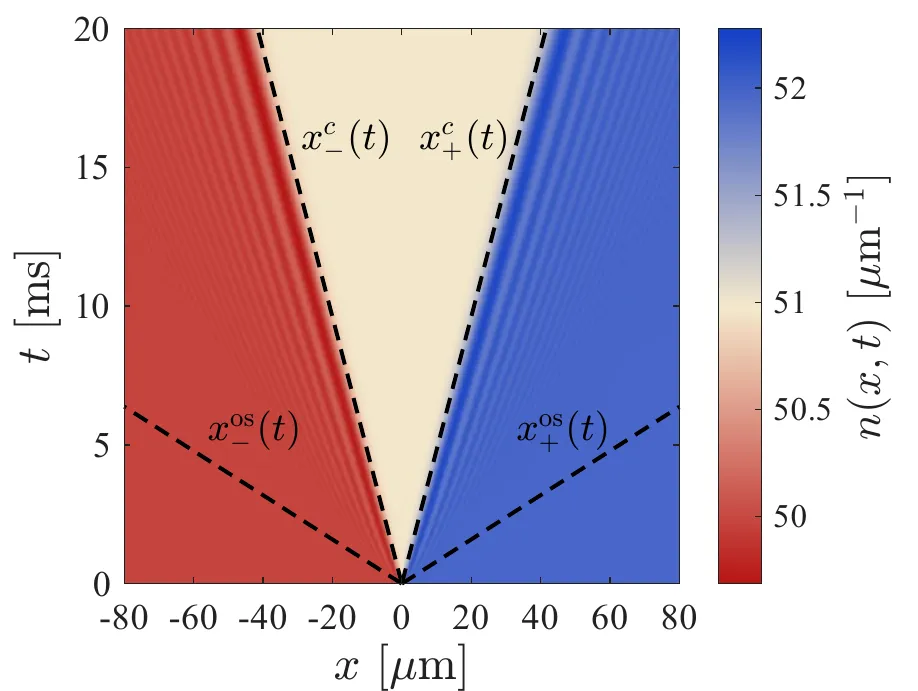
Density over the first 20 milliseconds: the two wavefronts (inner dashed lines) open a cone with no waves inside, while the undulations race ahead outside it. — Figure 2, Farrell et al. (2026), arXiv:2609.32232.
A double rainbow made of sound
Airy functions have a famous origin: G. B. Airy devised them to describe rainbows. That is no coincidence. Following the “rays” behind the ripples, the authors show that each wavefront is a fold caustic, a place where two rays merge — the same structure that concentrates sunlight into a rainbow at about 42 degrees.
The two wavefronts, back to back, reproduce the full ray pattern of a double rainbow. In the sky, the region between the primary and secondary bows looks darker: it is called Alexander’s dark band, after Alexander of Aphrodisias, who discussed it around 200 AD, according to the paper. In the condensate, the matching region is the plateau, where no sound wave travels — the authors call it a “silent band”. The faint arcs where a rainbow’s colours sometimes repeat, called supernumerary arcs, correspond to the quantum ripples. Unlike in the sky, the silent band widens over time, at twice the speed of sound.
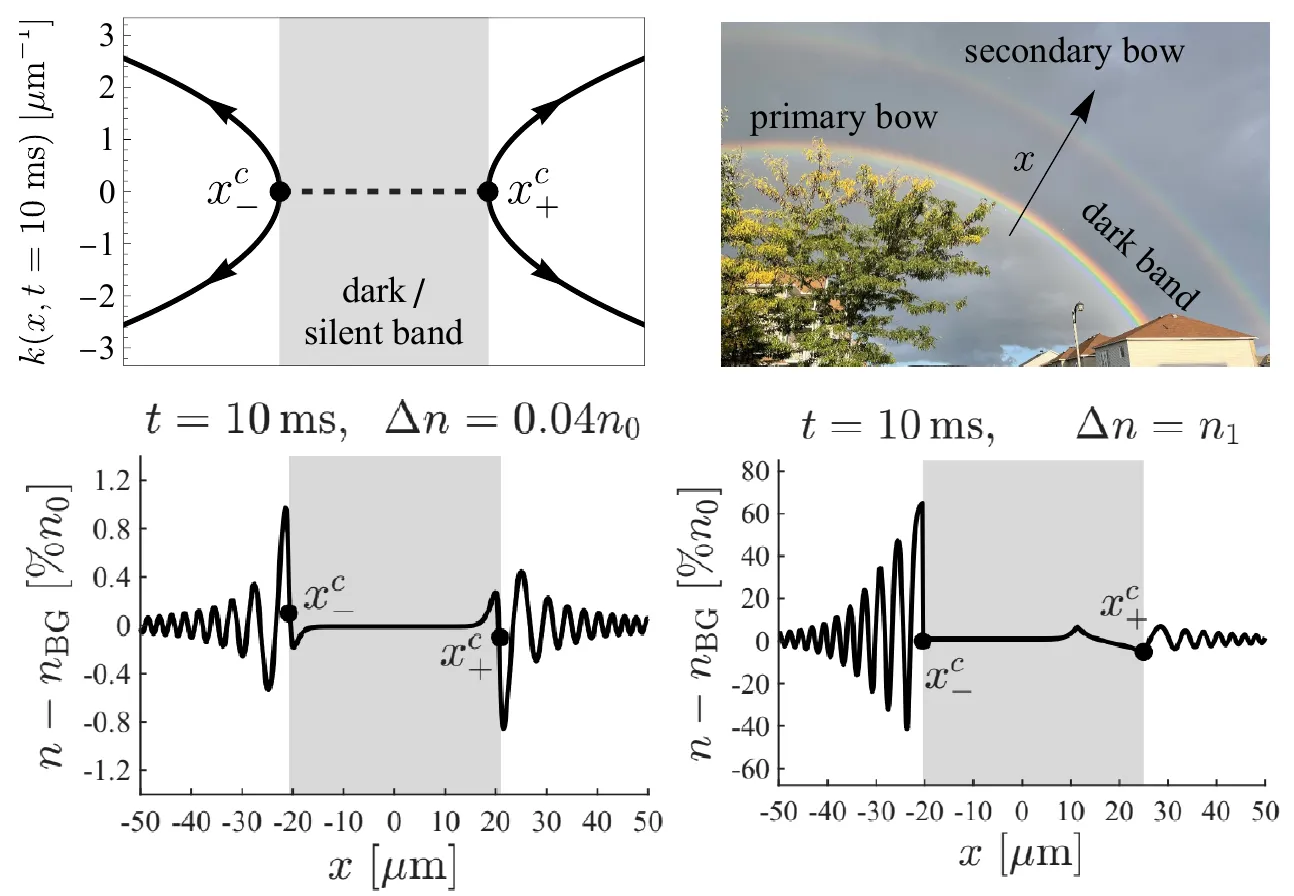
Top: rays of the dam-break waves (left) share the structure of a double rainbow and its dark band (right). Bottom: the ripples, for a small and a large density step. — Figure 9, Farrell et al. (2026), arXiv:2609.32232.
A horizon for sound
For larger density differences, the flow from the dense side can become faster than the local speed of sound. Sound waves can then no longer travel upstream: the fluid forms a sonic horizon, a laboratory analogue of the edge of a black hole. In the approximation that neglects quantum pressure, this happens once the density difference reaches 8/9 of the higher density. The horizon is not fixed: its strength, the analogue of a black hole’s surface gravity, weakens over time. In the full simulations, it appears after a brief delay of about half a millisecond, a quantum effect, then settles near the former dam. At exactly the critical density difference, an extended horizon forms over a whole region. River bores, by contrast, behave more like the time-reversed version, a “white hole”.
Making the ripples visible
To the authors’ knowledge, these dispersive waves have not yet been observed in freely expanding condensates; small ripples are hard to see above noise. They propose two strategies. Strengthen the atoms’ interactions before the break, then weaken them suddenly as the dam opens, which amplifies the upstream ripples in simulations. Or skip the dam altogether: push the whole condensate into motion inside a box-shaped trap, so that its edges launch the same kind of waves. The paper is a theoretical road map, waiting for a cold-atom laboratory to try it.