Ba a fassara ba tukuna: ainihin rubutun Turanci.
SPACE'S MISSING SULFUR MAY BE GLUED TO DUST
Count the sulfur in the universe and you find about 1.2 atoms for every 100,000 hydrogen atoms. Yet in molecular clouds, the cold, dense nurseries of stars, the sulfur-bearing molecules that telescopes detect add up to less than 5% of that budget. This long-standing puzzle is called the “missing sulfur” problem.
Most astrochemists suspect the rest is locked in solid form on dust grains. Candidates include iron and magnesium sulfides — found in meteorites and in samples brought back from the asteroids Ryugu and Bennu — salts, or pure-sulfur forms such as S₈, which are nearly impossible to see from afar. The textbook route, sulfur turning into hydrogen sulfide on the grains, clashes with observations: solid hydrogen sulfide is scarce. Calculations predicted that sulfur atoms should bind strongly to silicate dust. Nobody had checked it in the lab at realistic, tiny amounts.
Watching single atoms on cold dust
Ni-En Sie and colleagues at Hokkaido University, with partners at Hiroshima University, the CSIC in Madrid and RIKEN, worked in an ultra-high vacuum chamber with a surface cooled to 10 kelvin. The surface was coated with a 500-nanometre film of amorphous magnesium silicate, a stand-in for interstellar dust, sometimes covered with a layer of water ice.
They deposited a minute amount of hydrogen sulfide — a quarter of a percent of a single molecular layer — and broke it apart with an ultraviolet laser to leave bare sulfur atoms. Then came the key tool: one laser pulse gently knocks atoms off the surface, and a second one ionises only sulfur, so the team can count the sulfur atoms on the surface directly, as they are. Earlier experiments could not do that.
Atoms that refuse to leave
Each sample was warmed to 180 kelvin, by which point any water ice has evaporated, and the remaining atoms were counted.
- On bare silicate, half of the sulfur atoms remained (ratio 0.50 ± 0.13). Their signal then stayed constant through repeated warm-ups to room temperature: the sulfur is chemically bonded to the silicate, not just resting on it.
- Some atoms joined into S₂ molecules as the surface warmed — the first experimental evidence that sulfur clusters form on silicate even from a handful of atoms.
- Sulfur hardly evaporates on its own; what is lost mostly leaves together with the water when the ice sublimates.
- Atoms deposited on top of ice vanished from the surface signal by 150 kelvin, then reappeared at 160 kelvin as the water left: they had dug through the ice and latched onto the silicate underneath.
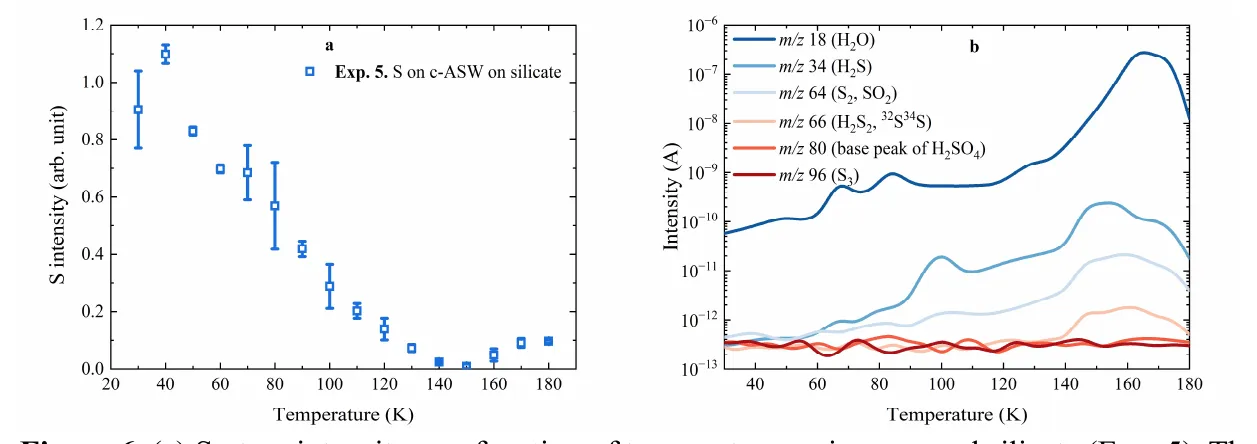
Left: sulfur atoms on ice-covered silicate disappear from the surface signal near 150 K, then come back at 160 K as the ice leaves. Right: gases released while heating a UV-irradiated sample. — Figure 6, Sie et al. (2026), arXiv:2609.37663.
Quantum chemistry calculations give a binding energy of about 9,700 kelvin for one sulfur atom on a magnesium site of a silicate grain, and suggest that turning that sulfur into hydrogen sulfide on the grain is unfavourable.
A hidden reservoir, and a test
The team then plugged these results into a model of a thin cloud turning into a dense one. Sulfur ions are neutralised and stick to the grains within a few hundred years. Before ice covers the grains, 10 to 20% of all the sulfur ends up chemically bound to them — two to four times more grain-locked sulfur than previously accounted for. Once bound, it stays invisible even after the ice is gone.
The model assumes all grains are silicate, and its numbers depend on poorly known surface properties. But it makes a prediction that can be tested: where shock waves heat the dust strongly enough, this hidden sulfur should be released — something the authors propose to look for with the James Webb Space Telescope.