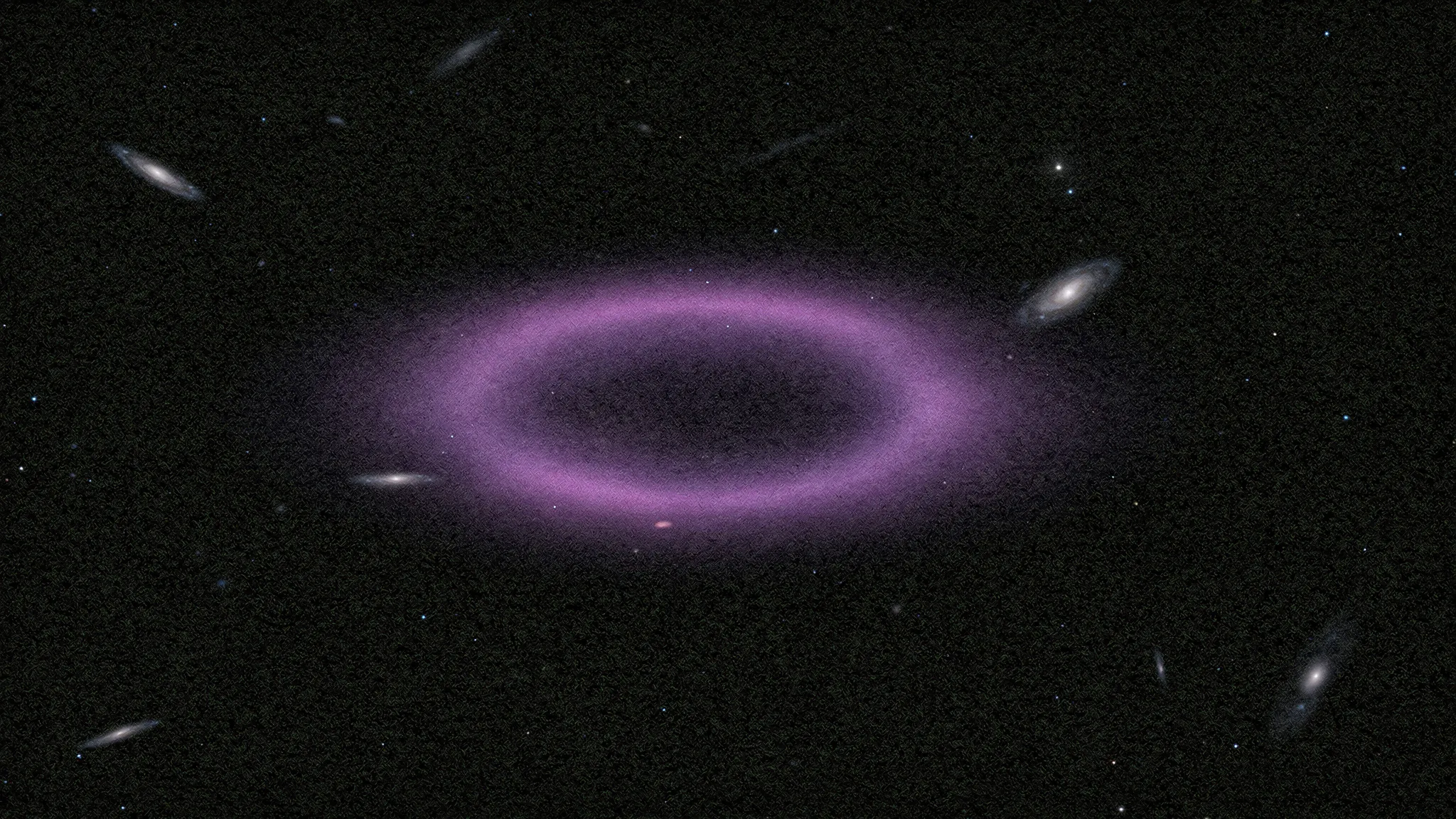
A GALAXY WITH ALMOST NO STARS
In the standard picture of the cosmos, small clumps of dark matter vastly outnumber large ones, and in the smallest of them star formation is thought to be choked off. Somewhere there should be a mass threshold below which a halo never lights up. If so, the universe should contain dark galaxies: haloes that hold neutral hydrogen, detectable by its radio line at 21 cm, but few or no stars.
Hunting them is treacherous. A candidate can turn out to have faint stars that earlier images missed — this happened to FAST J0139+4328, reclassified as a dim dwarf galaxy once deeper pictures came in. And radio telescopes suffer from interference: stray signals can mimic a faint source, and one survey even had to discard daytime data because of the Sun. The surest test is to see the same signal with two independent telescopes, at different sites, with different receivers.
Two telescopes, one signal
Marco Monaci, Duncan Forbes, Warrick Couch and Jean Brodie, at Swinburne University of Technology in Australia, did exactly that. They took 142 dark-galaxy candidates from the ALFALFA survey, made with the Arecibo radio telescope, and searched for them in FASHI, the all-sky survey of China’s 500-metre FAST telescope. Thirteen matched. After removing those near bright galaxies, those with a possible optical counterpart and those impossible to check, one remained: AGC 322753.
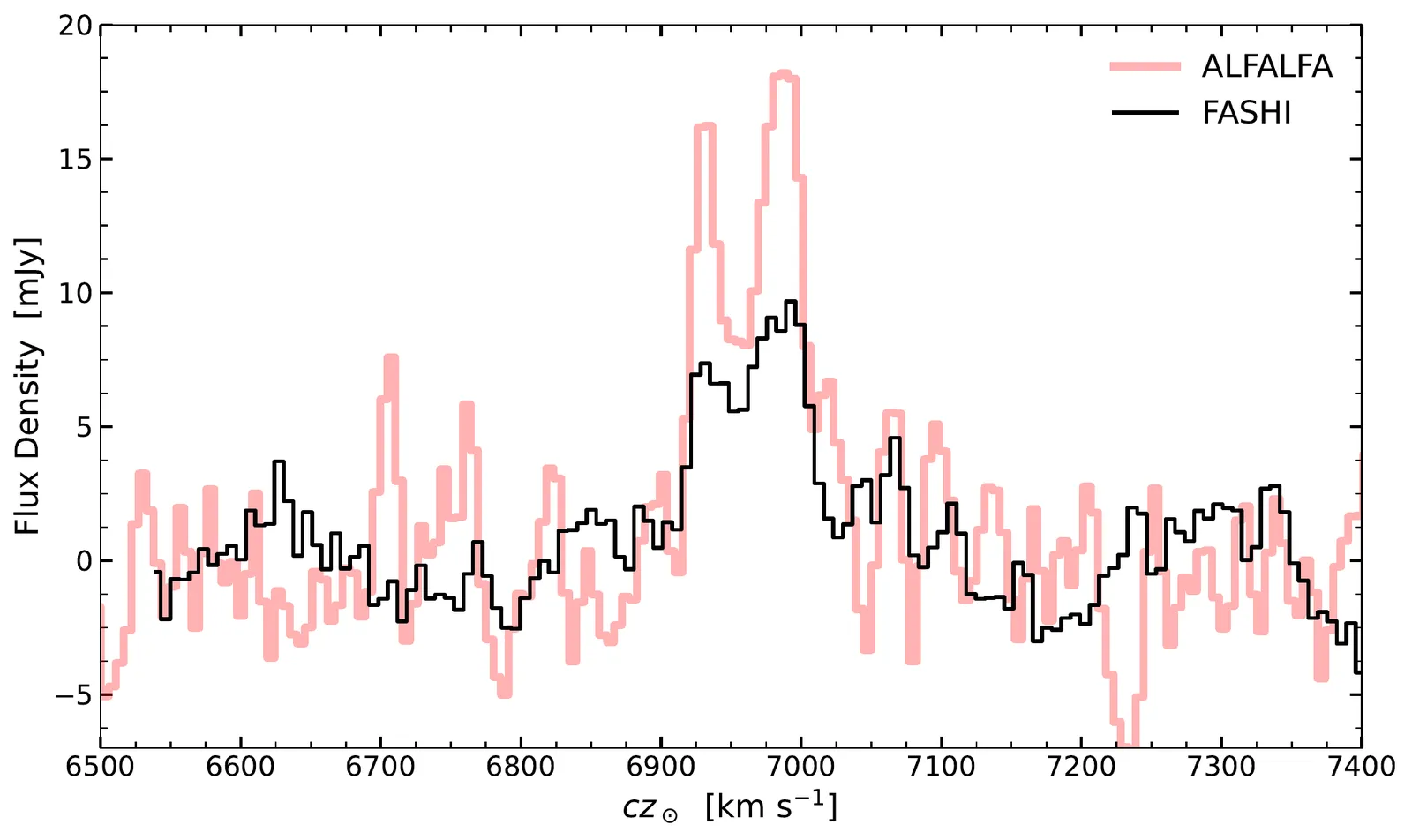
The hydrogen line of AGC 322753 seen by ALFALFA and by FASHI: same velocity, same double-peaked shape, the signature of rotation. — Figure 1, Monaci et al. (2026), arXiv:2609.39152.
The two detections agree closely: a recession velocity of about 6,965 km/s, a line width of 85 km/s, and a hydrogen mass of about 2 billion solar masses. Seen by two instruments at different times, the source cannot be interference. Its line has two peaks, the classic sign of a disc of gas in ordered rotation.
Looking for the missing stars
Each radio telescope only locates a source within a beam a few arcminutes wide. But the two beams overlap, and the overlap narrows the search. In DESI Legacy Survey images reaching about 27.5 magnitudes per square arcsecond — and in SDSS, Pan-STARRS, GALEX and WISE — nothing shows up there. The object that FASHI’s catalogue had linked to the source is a star of our own Galaxy, according to the Gaia catalogue; the only obvious galaxy in the field lies far in the background.
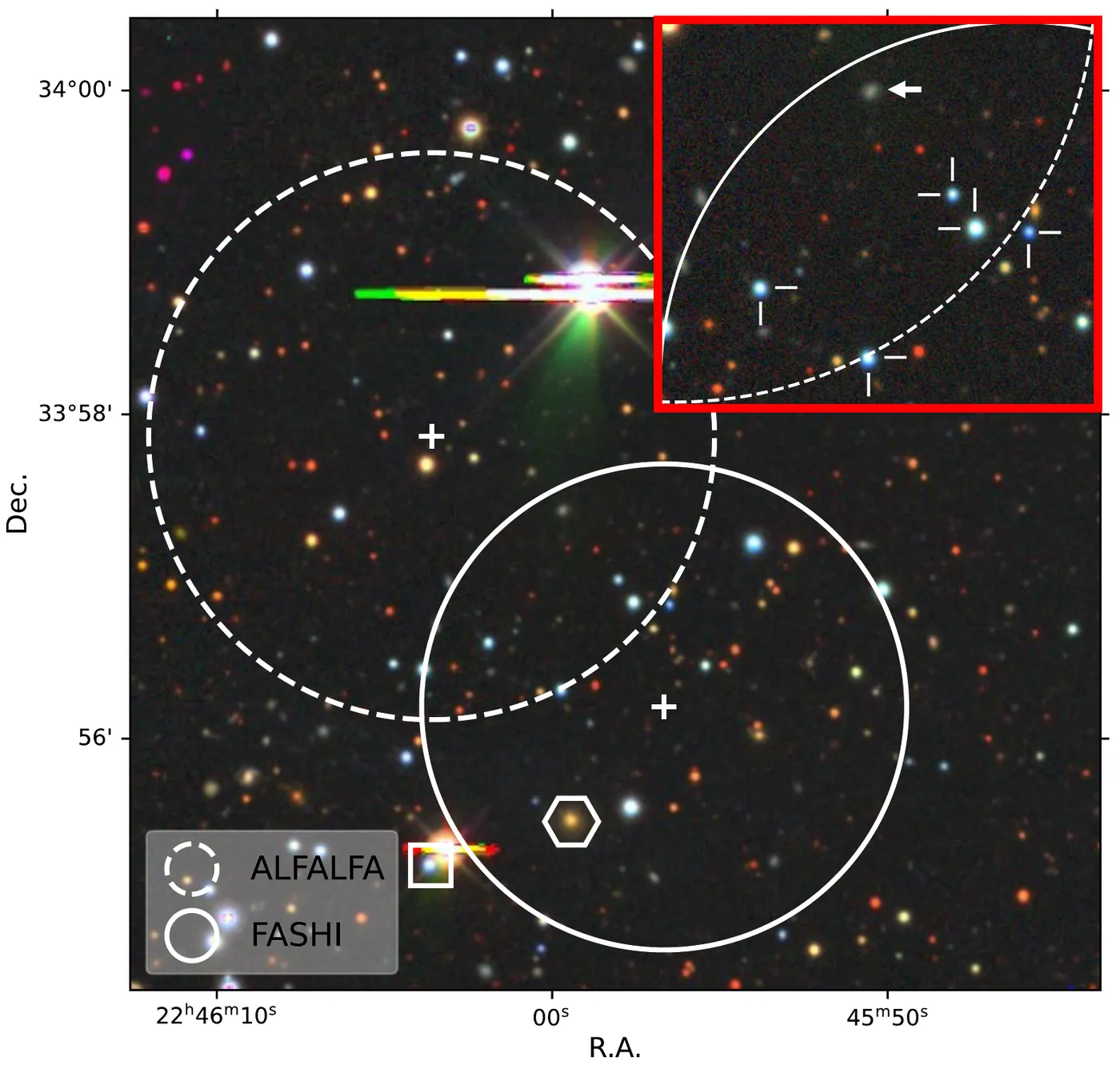
The Arecibo (dashed) and FAST (solid) beams; their overlap, enlarged in red, is the most likely place for any stars. Marked objects are foreground stars or background galaxies. — Figure 2, Monaci et al. (2026), arXiv:2609.39152.
To turn “nothing” into a number, the team planted fake galaxies in the images and checked which ones they could still see. The result: any stars weigh at most about 50 million solar masses, so hydrogen outweighs stars by at least 40 to 1. A faint dwarf galaxy once mistaken for a dark one sits at about 11.5.
Too heavy to be totally dark
AGC 322753 does not fit the simplest predicted dark objects, small non-rotating hydrogen clouds of at most 3 million solar masses. It is also heavier than any completely starless galaxy produced by current simulations. The authors therefore suspect it is not entirely dark, but hosts a sprinkling of stars too faint for today’s images.
It could still be a cloud torn from neighbouring galaxies, they concede, though the nearest ones lie 290 and 330 kiloparsecs away in projection and the gas rotates like a disc. A detailed radio map, from an array like the VLA, and deeper multi-band images will decide what kind of object sits in that empty patch of sky.