এখনও অনুবাদ হয়নি: মূল ইংরেজি সংস্করণ।
A LASER IN A CONTACT LENS
Pressure inside the eye is a key number for diagnosing and managing glaucoma. Yet it is measured only by medical staff, during clinic visits. Those occasional readings miss the swings that happen over the course of a day — swings the authors describe as critical for accurate diagnosis and treatment.
A contact lens is a natural place for a continuous sensor: it sits on the eye, and the paper notes that more than 140 million people already wear one. A soft lens follows the shape of the cornea, which bulges very slightly as pressure rises — a strain of roughly 0.1% for a few millimetres of mercury (mmHg), the resolution doctors need. Measuring such tiny stretches inside a thin, transparent piece of plastic is the hard part.
The limit of counting stripes
Several optical sensors read the strain of a lens from a regular pattern — a grating, a photonic crystal, two overlapping gratings — whose spacing changes as the lens stretches. Sergei Ivanov, Ilia Fradkin and colleagues at XPANCEO’s research centre in Dubai point out a fundamental catch: the precision of any such sensor is limited by the number of repeats in the pattern, a consequence of the uncertainty principle. In the few millimetres available in a lens, that bound is uncomfortably close to what is needed.
Their idea is to read something else: the colour of a laser.
A laser that stretches
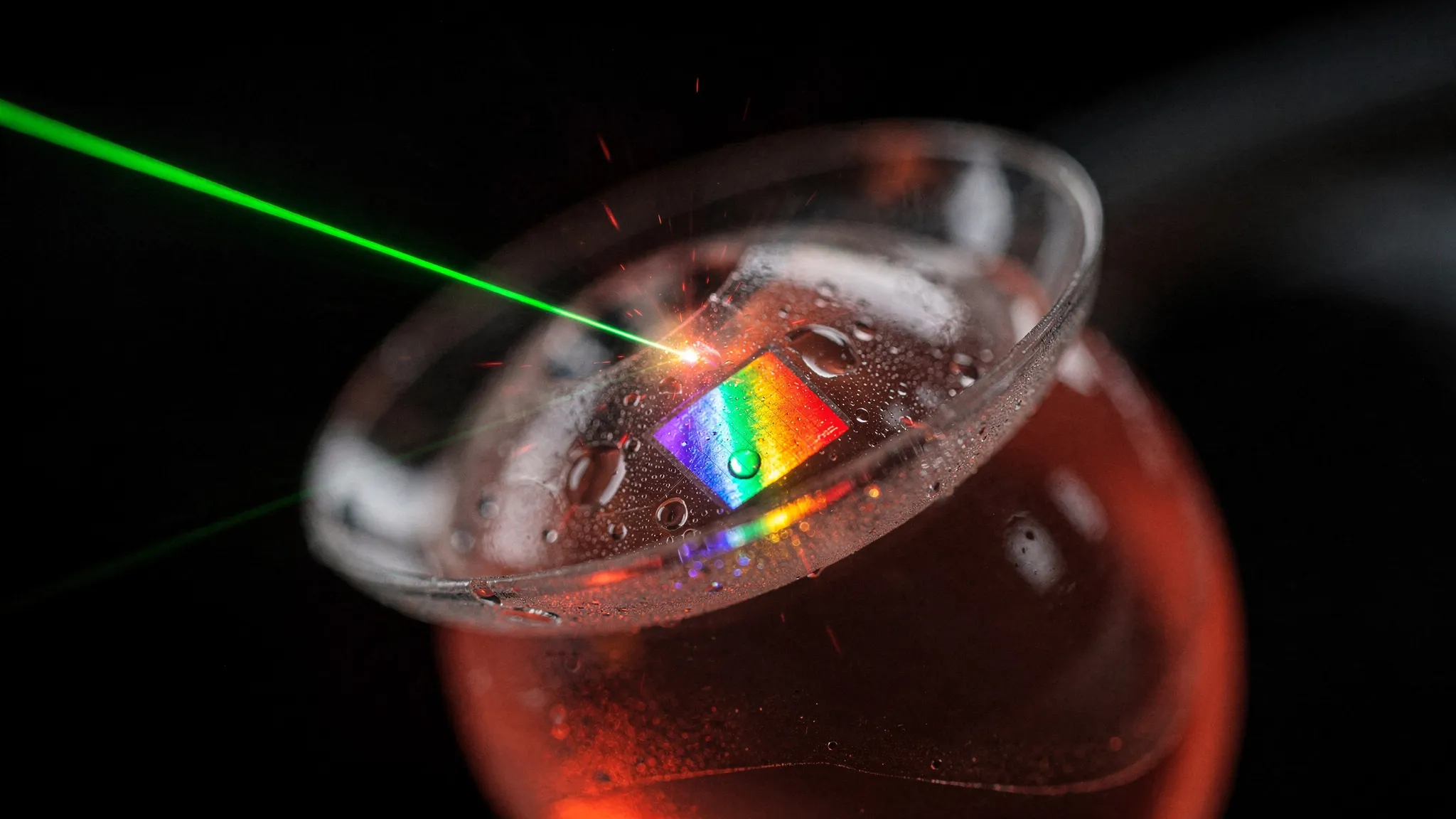
The team made a distributed-feedback laser: a film of an organic dye called F8BT, about 300 nanometres thick, with a surface rippled every 335 nanometres. The ripples act as the laser’s mirrors. When flashed with short pulses of green light, the film emits a very narrow line of yellow-green light at around 570 nanometres, coming out almost straight up.
The wavelength of that line is set by the ripple spacing. Stretch the lens, the spacing grows, and the line moves toward red. The advantage is not a bigger response — that part is ordinary — but a much narrower line, whose width does not depend on the size of the grating. A narrower line can, in principle, be located far more precisely.
The grating is written with ultraviolet light in a single exposure, copied into the dye, then floated onto the soft silicone lens at room temperature, without glue or pressure. The authors say the process is compatible with mass production of disposable lenses.
Testing on a fake eye
To test the device, they built an artificial eye: a silicone membrane shaped like a cornea and sclera, over a chamber pressurised by a motorised syringe, with silicone oil standing in for tears. Its cornea rises by about 150 micrometres at 40 mmHg, and the authors show it deforms on the same scale as a real eye — while stressing it is a strongly simplified model.
With the laser patch placed near the edge of the cornea, where the lens stretches most, they raised the pressure to 45 mmHg and back down once. The laser line shifted to the red as pressure rose, by 0.027 nanometres per mmHg. Over ten calibration points, readings deviated from a straight line by 1.2 mmHg on average — the order of precision needed for monitoring.
The authors are candid about what this means. That precision is of the same order as the theoretical limit of a passive grating of the same size; it does not beat it yet. The current bottlenecks are the spectrometer and pressure gauge used in the lab, and part of the error comes from the test rig itself.
Still a long way from the eye
The discussion lists what remains to be done:
- Safety: each reading uses one 8-nanosecond flash; the light reaching the retina is estimated at about ten times below the measured injury threshold.
- Integration: the pump laser and spectrometer are external today; the team suggests small green laser diodes and miniature wavelength readers.
- Temperature: warming the lens by one degree shifts the reading by about 2 mmHg, so a real device must measure temperature too.
- Biocompatibility: the dye film sits on the surface for now; it would need to be sealed inside the lens and tested.
Validation on animal eyes, then in people, is still ahead. The authors, all from the company XPANCEO, declare no competing interests other than a patent application on the work held by the company.