
尚未翻译:以下为英文原文。
WHICH NEUTRINO IS THE HEAVIEST? JUNO LEANS ONE WAY
Neutrinos are famously hard to catch. The discovery that they “oscillate” — change type as they travel — established that they have a mass. There are three types (or “flavours”) of neutrino, and each is a blend of three mass states. Physicists have measured how far apart those masses are. They still do not know in which order they come.
Two options remain. In the normal ordering, the third mass state is heavier than the first; in the inverted ordering, it is lighter. Experiments with accelerator beams and with neutrinos from the atmosphere probe the question through the way matter bends oscillations, but their answer is tangled with other unknowns. The Jiangmen Underground Neutrino Observatory (JUNO) attacks it differently: from the pure, vacuum oscillation of antineutrinos coming out of nuclear reactors.
A giant sphere under a hill
JUNO sits beneath Dashi Hill in Guangdong, China, under 650 metres of rock. Its heart is 20,000 tonnes of liquid scintillator — a liquid that glows when a particle passes — inside an acrylic sphere watched by about 17,600 large and 25,600 small light sensors.
The antineutrinos come from the eight reactor cores of the Yangjiang and Taishan nuclear power plants, on average 52.5 kilometres away. When one hits a proton, it produces a positron and a neutron. The flash of the positron gives the energy; the capture of the neutron a moment later confirms the event.
At that distance, the energy spectrum carries a slow wave with fast ripples on top. The ripples hold the mass ordering. Reading them demands an exceptional energy resolution — about 3.5% at the centre of the detector — and a perfect knowledge of the reactor spectrum before any oscillation. For the first time, the team used for this a small detector placed right next to a Taishan core, TAO.
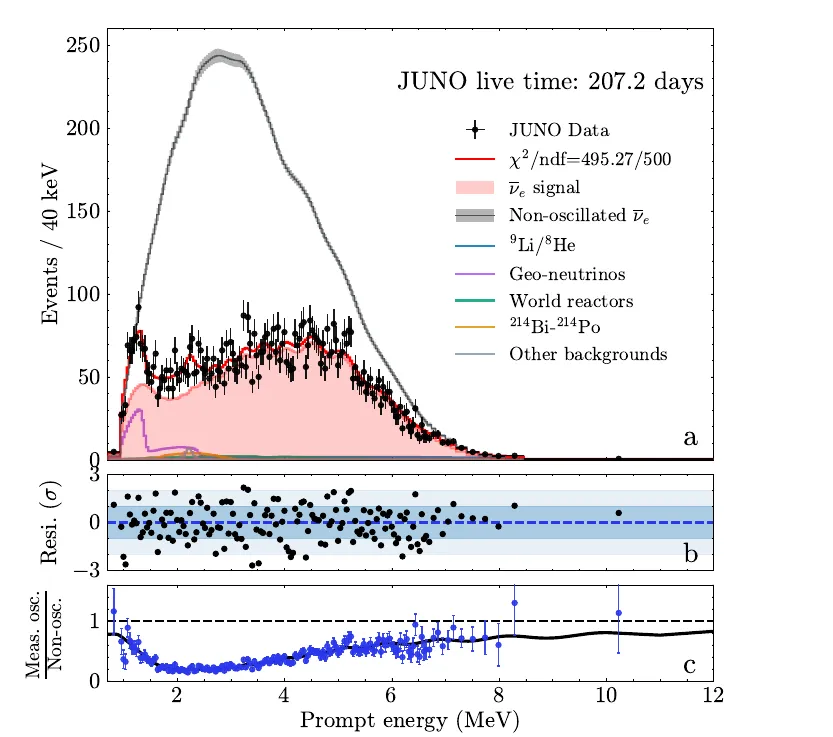
Energy spectrum of the 8,294 events: the data (black) sit far below what would be seen without oscillation (grey). — Figure 3, JUNO Collaboration (2026), arXiv:2609.37895.
207 days, 8,294 antineutrinos
The analysis covers 207.2 days of data, from 30 August 2025 to 18 May 2026 — more than three times the first JUNO analysis. It was done blind, and three independent groups ran it in parallel with consistent results.
- The “solar” parameters, which drive the slow wave, reach 2.1% and 1.1% precision: the most precise measurements in the world, now improved again.
- The large mass gap, Δm²₃₁, is measured by JUNO for the first time, to about 1%: +2.509 × 10⁻³ eV² if the ordering is normal, −2.482 × 10⁻³ eV² if inverted.
With this amount of data, JUNO alone still sees several possible solutions for that gap; an earlier measurement by the Daya Bay experiment picks the right one, and JUNO sets the precision.
A hint toward “normal”
To weigh the two orderings, the team added the mass-gap values measured by accelerator experiments. The tension between reactor and accelerator results is larger under the inverted hypothesis. Result: the inverted ordering is disfavoured at 2.1 sigma (a p-value of about 2%), whatever the value of the unknown CP phase. An independent Bayesian analysis gives odds of 10.18 to 1 in favour of the normal ordering.
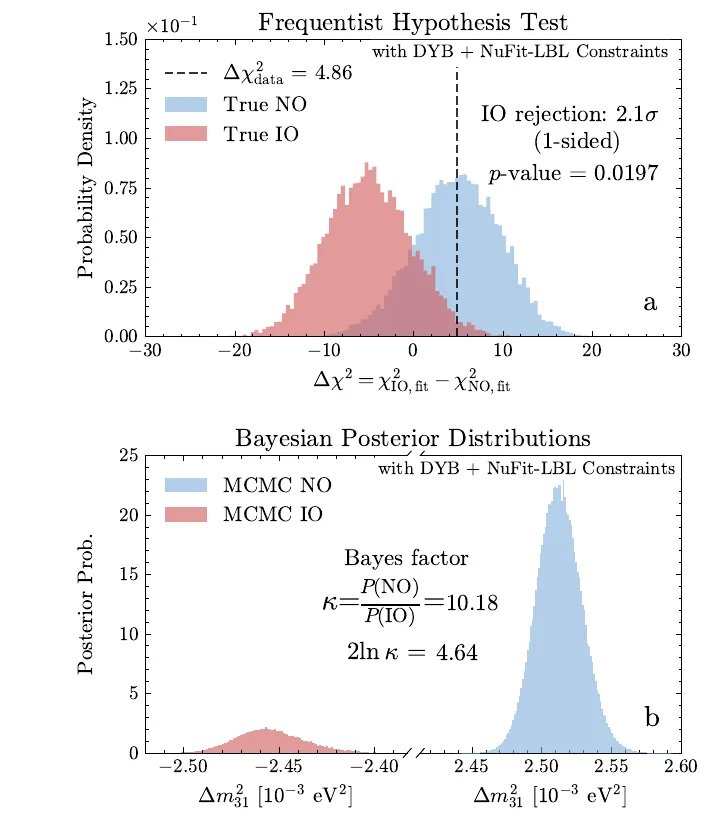
Top: the measured value (dashed line) against simulated experiments for each ordering. Bottom: the Bayesian analysis, with a factor of 10.18 for normal ordering. — Figure 8, JUNO Collaboration (2026), arXiv:2609.37895.
The collaboration calls it an “indication”, the first from JUNO. A real discovery needs a much higher significance, and more years of data. Along the way, the detector also measured the flux of geoneutrinos — antineutrinos from uranium and thorium inside the Earth — with what the authors describe as the largest sample of candidates ever collected.
The JUNO Collaboration lists 62 institutions, including the Institute of High Energy Physics in Beijing.