Chưa có bản dịch: bản gốc tiếng Anh.
HUBBLE CATCHES A LAVA WORLD'S GLOW
Some rocky planets orbit so close to their stars that they have no counterpart in our Solar System. Astronomers call them lava worlds: planets smaller than about 1.9 times Earth’s radius, whose surface under the star exceeds 1,500 kelvins. They are expected to always show the same face to their star, so their day side stays permanently scorching — hot enough for an ocean of magma, and possibly a thin atmosphere of vaporised rock.
TOI-2431 b is an extreme example. It orbits a nearby star of the type called a late K dwarf in 5.4 hours, the shortest period known among planets whose radius and mass have both been measured. It is 1.53 times wider than Earth and about 6.2 times as massive, with a density consistent with a mostly rocky world. Under its star, its surface would receive enough energy to reach about 2,850 kelvins.
Watching a planet disappear
When a planet passes behind its star, the system’s total light drops by exactly the amount the planet itself was emitting or reflecting. This secondary eclipse measures the light of the planet’s day side. Following the light over a whole orbit — the phase curve — also shows how much heat reaches the night side.
Sebastian Zieba, of the Harvard & Smithsonian Center for Astrophysics, and 20 co-authors analysed Hubble observations taken on 4 February 2022, spanning 11 orbits of the telescope and about three orbits of the planet, in near-infrared light (1.1 to 1.6 micrometres). They combined them with data from NASA’s TESS satellite, which observed the star in visible light between 2020 and 2023.
The faintest of dips
Hubble detected the eclipse with a depth of 69 parts per million (+14/−13) — the planet’s day side shines with less than a ten-thousandth of the star’s near-infrared light. A second, independent analysis of the same data found 60 ± 14 ppm. TESS gives 37 ± 10 ppm in visible light. The authors describe it as the first secondary eclipse of a rocky exoplanet detected with Hubble.
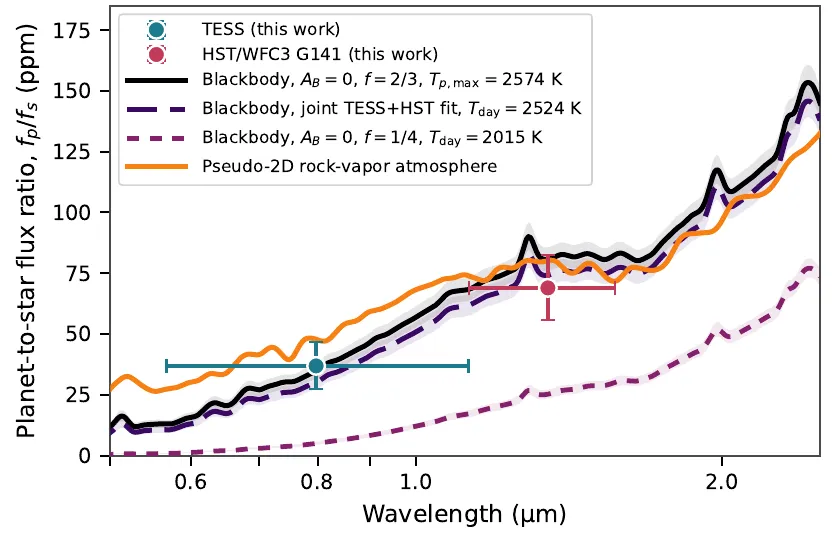
The measured TESS and Hubble eclipse depths (dots) lie close to the curve for the hottest possible day side (solid black), far above the case where heat is spread over the whole planet (dotted). — Figure 2, Zieba et al. (2026), arXiv:2609.31966.
As hot as it can get
If all that light is heat, the two measurements together give a day-side temperature of 2,524 kelvins (+77/−84). That is 98% of the theoretical maximum of 2,574 kelvins — the value expected if the planet reflected nothing and kept all its heat on the day side. The phase curve agrees: it is consistent with a night side giving off no measurable light, and with a hottest point right under the star.
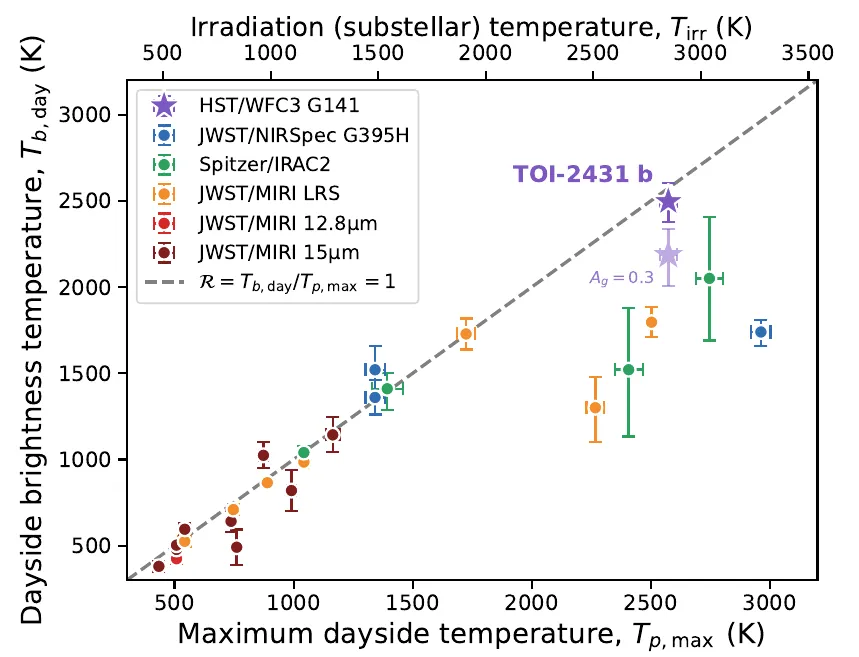
Rocky exoplanets with measured day sides: TOI-2431 b (star) sits on the line of maximum temperature, while several other lava worlds fall below it. — Figure 4, Zieba et al. (2026), arXiv:2609.31966.
That sets TOI-2431 b apart. Several lava worlds observed so far, including 55 Cancri e and K2-141 b, have day sides markedly cooler than their maximum, a sign of an atmosphere carrying heat away, reflective surfaces or clouds. TOI-2431 b does not appear to share that behaviour.
A reflection problem
There is a caveat the authors spell out. At these wavelengths, reflected starlight and the planet’s own heat glow look alike. If the surface reflects even 10% of the light — a value inspired by laboratory measurements of silicate rocks — reflection would contribute about 11 ppm in each band, and the day side would be closer to 2,400 kelvins. More reflective, cooler solutions remain possible.
A model of a vaporised-rock atmosphere, with a pressure of at most about 20 millibars under the star and sodium as its main gas, also fits the data, but cannot yet be distinguished from a bare glowing rock.
Waiting for Webb
The way out is longer wavelengths, where heat dominates and reflection fades. The James Webb Space Telescope is scheduled to watch a full 10.6-hour orbit, including two eclipses, with its MIRI instrument between about 5 and 12 micrometres. The team predicts an eclipse about four times deeper there, enough to separate heat from reflection and to look for the fingerprints of silicon oxides in a rock-vapour sky.