ابھی ترجمہ نہیں ہوا: اصل انگریزی متن۔
ONE SHEET, MANY ORIGAMI
Origami has become an engineering tool: foldable structures for space, robots, medicine and architecture. An origami is made of rigid panels joined by flexible hinges. From a flat sheet, the same pattern can often fold in several ways, depending on whether each hinge folds up (a mountain fold) or down (a valley fold).
The traditional way to choose is to crease the hinges. But a crease is permanent: the sheet cannot later fold into another shape. Other solutions — small motors at each hinge, or patterns that are naturally multistable — need motors or only work for a few patterns.
A strip that snaps
Leon Kamp, Katia Bertoldi, L. Mahadevan and colleagues at Harvard University, with partners at PSL University in Paris and Delft University of Technology, found a simple trick. Across each hinge, they slip a spring-steel strip only 0.05 millimetres thick, slightly longer than the gap it sits in. Squeezed, it buckles into an arch. It has two stable states — bowed up or bowed down — and a press of a finger flips it from one to the other.
Bowed one way, the hinge folds easily as a mountain and resists as a valley; bowed the other way, the opposite. At 65 degrees, the hinge is about 4.3 times stiffer in its “hard” direction than in its “easy” one.
One sheet, several shapes
- With two strips per hinge, a hinge gains a third state: locked flat.
- A sheet of triangles starts locked. Flipping 23 strips turns it into a flat, pleated Miura-ori. Flipping 30 more turns it into a cylinder-like Yoshimura pattern — two patterns with different geometry.
- The length of the strip sets the angle at which the hinge rests, anywhere from 0 to 180 degrees. Combining two different strips gives a hinge two resting angles. One kite-shaped sheet folds into a bird or a whale, within about 4 degrees of the target angles; another into a box or a boat.
- With up to four strips per hinge, a chain of 10 panels forms every letter of the word ORIGAMI.
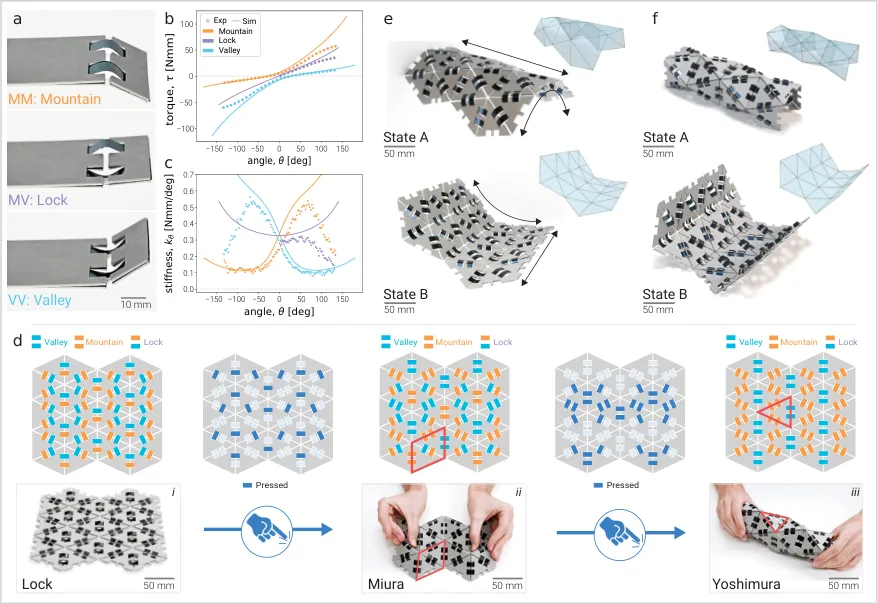
With two strips per hinge, the same triangulated sheet goes from locked flat to Miura-ori to Yoshimura. — Figure 2, Kamp et al. (2026), arXiv:2609.28790.
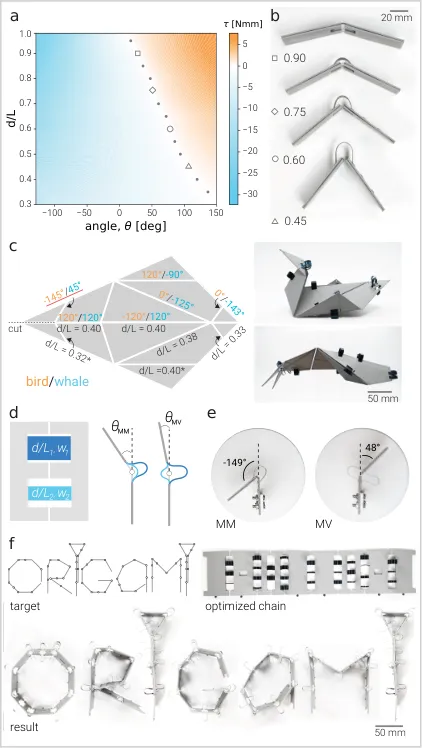
Tuning the rest angle of each hinge with the strip length: one sheet folds into a bird or a whale, and a chain spells ORIGAMI. — Figure 3, Kamp et al. (2026), arXiv:2609.28790.
Sheets that reprogram themselves
Pressing strips one by one is slow. So the team offset the strips from the hinge axis: past a critical angle, such as 68 degrees, a strip flips on its own. Folding the edges of the sheet then reprograms it. The sheet even corrects a defect: a strip deliberately put in the wrong state is snapped back by the folding of its neighbours.
Other variants:
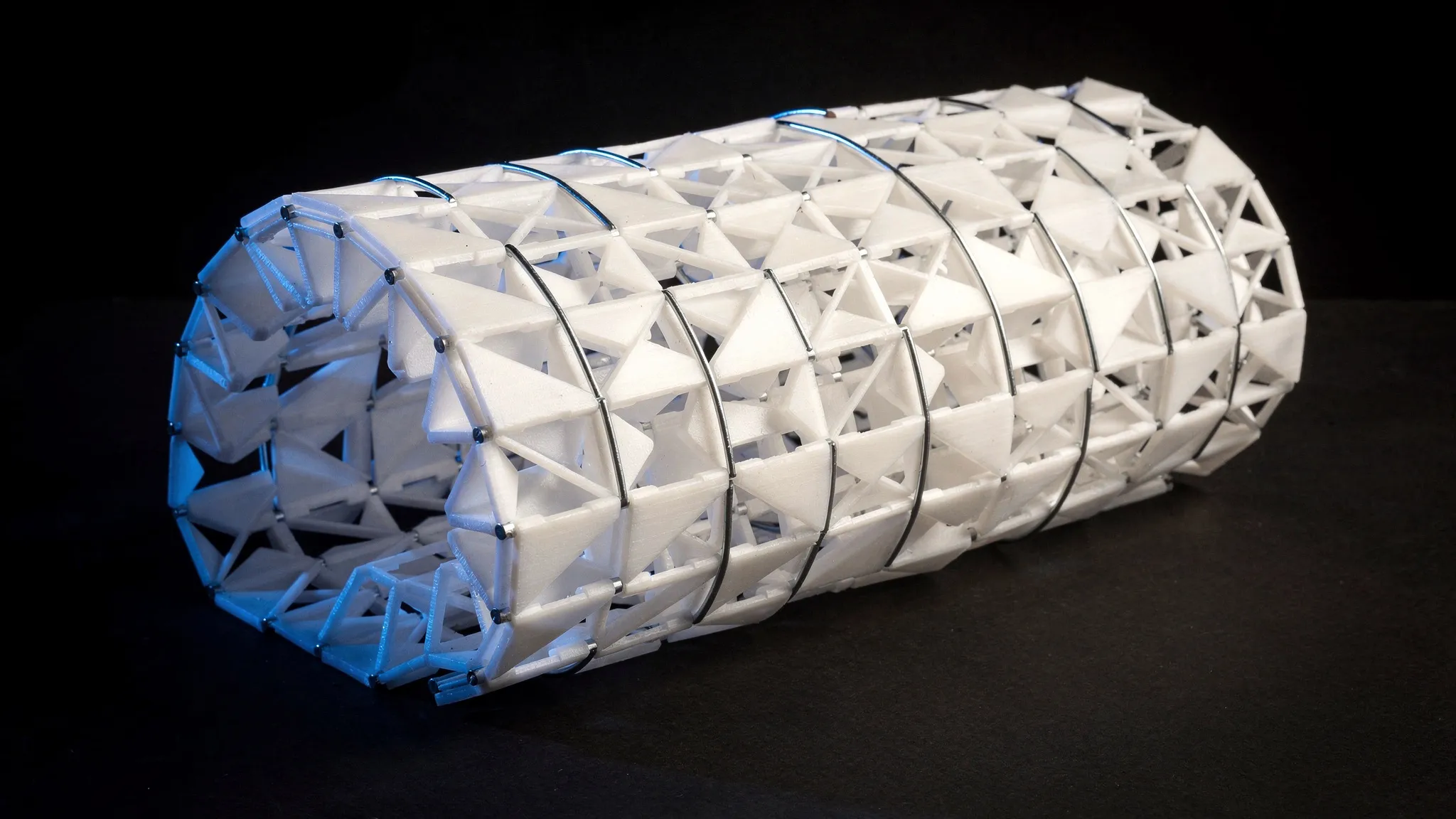
- A compact stack of panels that unfolds by itself into a flat sheet — or into an arch — when you simply pull its edges.
- Hinges with small strings that flip their strip at every fold, making a sheet that counts how many times it has been squeezed.
What’s next
The shape and the path from one shape to another are written into the mechanics of the hinges, with no electronics. The authors see applications in deployable and reconfigurable structures, and plan to automate the design. Limits remain: a deployed structure is hard to fold back without resetting each hinge, and edge-folding cannot yet reach every possible pattern.