Henüz çevrilmedi: İngilizce özgün metin.
100 ATTOSECONDS, 10 TERAWATTS
An attosecond is a billionth of a billionth of a second. Light pulses that short give direct access to the motion of electrons in atoms, molecules and solids, on their natural timescale — a field recognised by the 2023 Nobel Prize in Physics. Tabletop sources produce attosecond pulses, but with limited energy, especially at short wavelengths. That rules out “strongly driven” experiments, where the light drives the electrons strongly.
Free-electron lasers overcome that limit. In these machines, a beam of electrons moving at nearly the speed of light crosses a long row of alternating magnets, an undulator. Tiny density fluctuations in the beam amplify themselves until the electrons radiate an intense X-ray flash. Several such facilities already make attosecond X-ray pulses routinely, up to hundreds of microjoules.
The shorter the bunch, the shorter the flash
To get an attosecond flash, the bunch of electrons that lases must itself be extremely short. Evgeny Schneidmiller and 37 colleagues at DESY, the European XFEL, TU Dortmund, and the universities of Hamburg and Kassel went to the extreme at the European XFEL, the superconducting X-ray laser in Schenefeld, Germany.
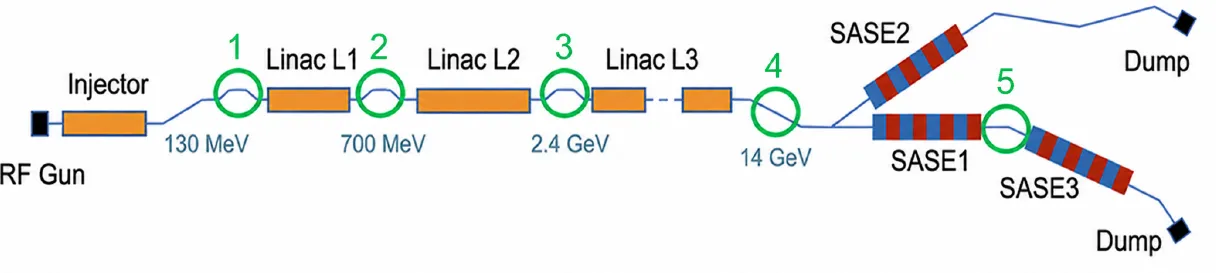
Layout of the European XFEL: the five compression stages used in this work are circled in green. — Figure 1, Schneidmiller et al. (2026), arXiv:2609.31534.
Five squeezes instead of three
In normal operation, the bunches pass through three magnetic “chicanes” that shorten them, and the last one deliberately compresses only partly. The team changed everything:
- The third chicane now fully compresses a fairly heavy bunch of 350 picocoulombs.
- A collimator section, normally neutral, becomes a fourth stage: running the beam at 14.3 GeV, 300 MeV above its nominal energy, activates a second-order effect that compresses it further.
- The bend between two undulator lines becomes a fifth stage, by detuning a pair of focusing magnets. The bunch has picked up the right energy spread while crossing a 200-metre undulator upstream.
Simulations show the bunch squeezed below a micrometre, with a peak current of 150,000 amperes — exceptionally high for an X-ray laser, though not directly measurable on this beamline. The high electron energy is the key: at the 3–4 GeV used for soft X-rays elsewhere, the energy spread of such a bunch would stop the laser from working, the authors note.
Millijoules in an attosecond
Three experimental runs, in 2025 and 2026, produced X-ray flashes at 1,000 electronvolts (a wavelength of about 1.2 nanometres). Depending on the run, 20 to 39% of the pulses showed a single clean spike in their spectrum, with average energies of 1.2 to 2.0 millijoules. Individual pulses reached 3 millijoules, with spectral widths of 10 to 30 eV.
The duration is inferred from the spectrum: a pulse 18 eV wide corresponds to about 100 attoseconds at best. Plotting width against energy, 57% of the single-spike events lie above the line corresponding to 10 terawatts of peak power under that ideal assumption, and 6% even under a pessimistic one.
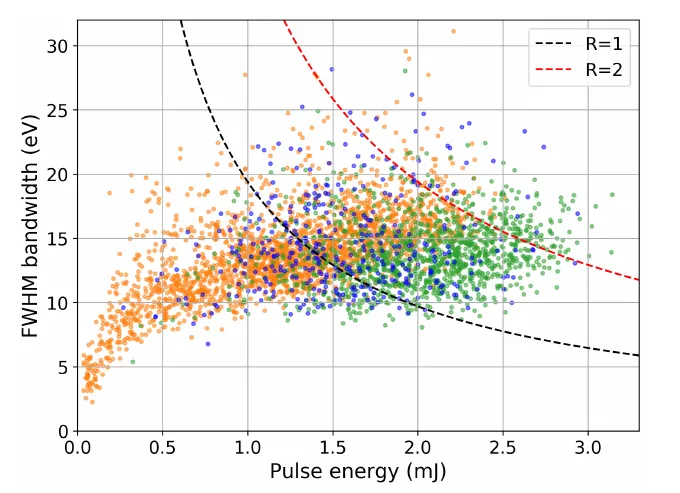
Each dot is a single-spike X-ray pulse. Dots above the dashed curves correspond to peak powers above 10 terawatts. — Figure 4, Schneidmiller et al. (2026), arXiv:2609.31534.
Chosen one by one
The duration is not measured directly in time: a spectrum gives no access to the phase of the light, so the estimate rests on a standard model and on recent measurements showing that such pulses sit close to their shortest possible duration. Shots also fluctuate strongly from one to the next. But the European XFEL delivers up to tens of thousands of pulses per second, and each pulse’s energy and spectrum can be recorded without destroying it. Users will be able to keep only the shortest, most intense flashes — a new regime, the authors write, for watching electrons pushed to their limits.