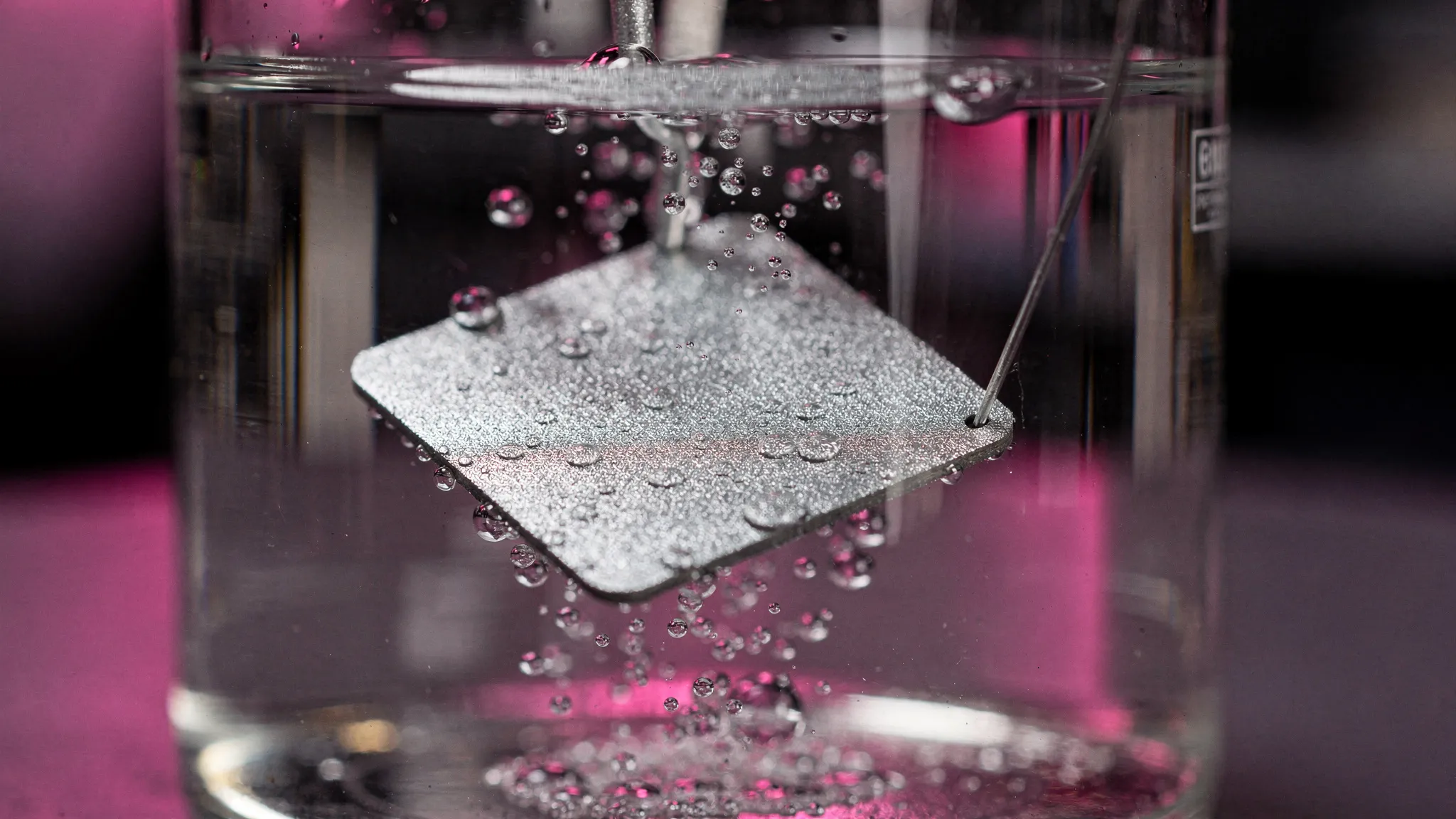
Henüz çevrilmedi: İngilizce özgün metin.
AN AI FINDS A WAY AROUND IRIDIUM
To produce clean hydrogen, electrolysers split water with electricity. In the most compact type — proton-exchange-membrane (PEM) electrolysers — one electrode must release oxygen in a strongly acidic, highly oxidising environment. There, only oxides of iridium or ruthenium are both active and durable enough.
Their cost is not the main problem: the price of hydrogen depends more on efficiency and lifetime. The problem is supply. Iridium ranks among the rarest elements used in industry, ruthenium is barely more common, and both come as by-products of platinum-group mining, through a concentrated and rigid supply chain. Scaling electrolysers up to gigawatts could hit that wall.
A laboratory that chooses its own experiments
A team at Lila Sciences, a company in Cambridge, Massachusetts, built a closed-loop platform that is over 90% automated. Humans only move samples and start the instruments.
- Machines deposit thin films mixing several metal oxides — 32 samples per batch, three compositions each.
- The films are measured, then tested in sulphuric acid: how easily they release oxygen (activity) and how much metal they lose (stability).
- Machine-learning models are retrained after every round. An agent decides whether to explore new regions or refine good ones, and a language model picks the next experiment and explains why.
A minimal cycle takes about 22 hours; the platform tests about 240 catalysts per week.
An unexpected family
After 2,942 catalysts from 53 families and 26 elements, the best trade-offs between activity and stability were dominated by palladium-rich oxides with tiny amounts of other metals. This was a surprise: palladium oxide alone is known as a poor catalyst for this reaction, and no such family had been described.
The standout, InMnPdOx, is 99.91% palladium, with only 0.06% manganese and 0.03% indium.
- Starting performance: close to ruthenium oxide (0.45 versus 0.41 volt of overpotential — lower is better).
- Endurance: it stayed below 0.5 volt for 1,000 hours. Plain palladium oxide crossed that line after about 200 hours; its nickel-tantalum cousin after about 470.
- It kept 96% of its palladium after 1,000 hours, against 87% for plain palladium oxide and 59% of the ruthenium in ruthenium oxide.
- The best catalysts without any precious metal, based on cobalt, failed in under four hours.
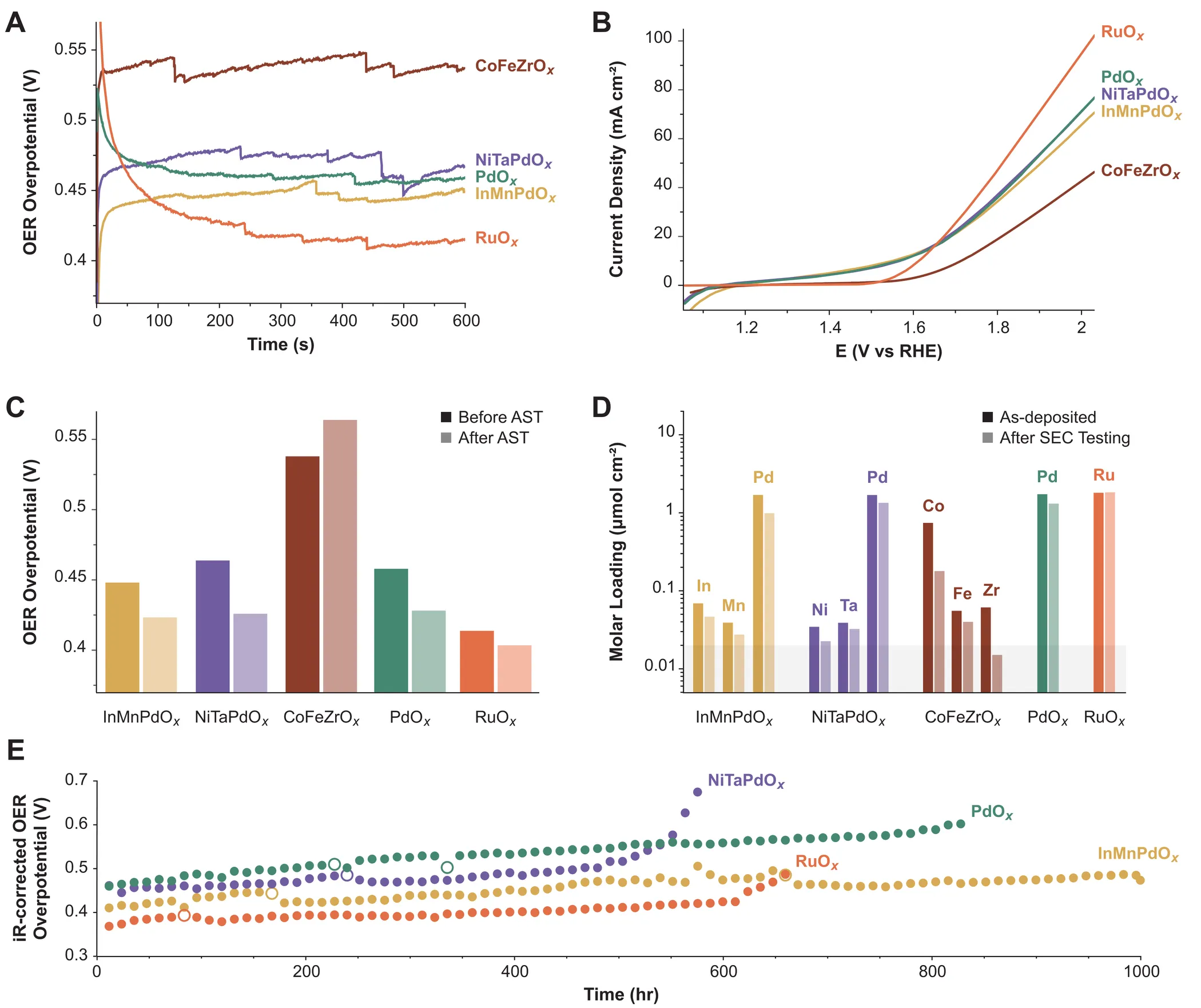
Benchmark of the palladium leads against ruthenium oxide: activity, stability and metal loss, and (E) the long-term test over 1,000 hours. — Figure 3, Jenewein, Habib Zadeh et al. (2026), arXiv:2609.30133.
Why does it last? During operation, InMnPdOx grows a network of needle-like nanostructures, domains no larger than 2 nanometres. Its surface chemistry is the same as plain palladium oxide: according to the authors, the structure makes the difference.
AI versus chatbot
Replaying the search on the real data, the team’s agent improved the best trade-offs faster than every other strategy. Standard Bayesian optimisation did about as well as random choice — and a language model alone did worse than random. To reach the palladium family with 90% probability, the agent needed 11 material families, random search 18; the language model (Claude Opus 4.6) never got there within 50.
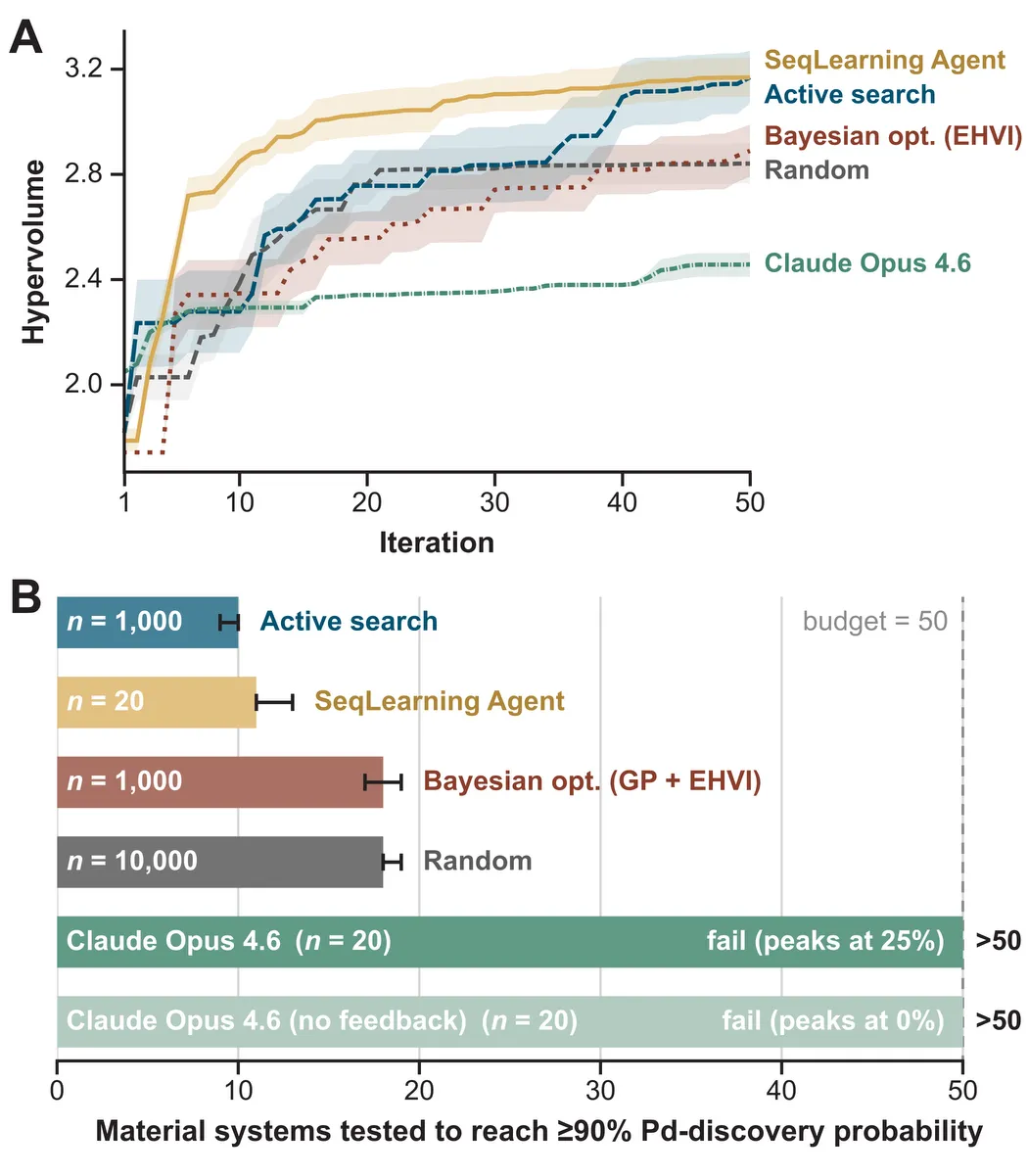
The AI agent against other strategies (A) and how many material families each needed to find palladium (B): the language model alone never got there. — Figure 5, Jenewein, Habib Zadeh et al. (2026), arXiv:2609.30133.
A near-term option, not a final answer
Palladium is also a precious metal. But its annual production is more than ten times that of iridium, its main historical use — car exhaust catalysts — is declining with electrification, and it is recycled through more diverse channels. It relaxes the constraint without removing it.
Conflict of interest: all authors are employees of Lila Sciences, which funded the work and has filed or may file patents on these materials and the platform. The mechanism behind the durability still has to be established.