未翻訳:英語の原文を表示しています。
A STRANGE HIT IN A DARK MATTER TRAP
Dark matter makes up most of the matter in the universe, yet no one has ever caught a particle of it. For decades, the favourite candidates were slow, heavy particles called WIMPs. Giant tanks of liquid xenon, buried deep underground, wait for one of them to bump into a xenon nucleus and make it recoil.
One event that does not fit
The LUX-ZEPLIN experiment (LZ) recently widened its search to stronger collisions. In its main energy window, from 5.4 to 50 kiloelectronvolts, it saw nothing unusual. But higher up, it recorded a single event at 248 kiloelectronvolts, in a region where almost no background noise is expected. Its local significance is 3.4 sigma: intriguing, not a discovery.
The problem is kinematic. To hit a xenon nucleus that hard, a particle must carry a large momentum — about 246 MeV/c. Dark matter drifting slowly through our Galaxy cannot do it unless it is very heavy, over about 74 times the mass of a proton. But heavy models of that kind are largely ruled out by the silence at low energy.
Fast, light particles from dying black holes
Another way to deliver such a blow is a particle that is light but extremely fast. A natural source: primordial black holes, which some theories say formed in the very early universe. Those with the mass of an asteroid — 10¹¹ to 10¹³ grams — would be evaporating today through Hawking radiation, spraying out every kind of particle lighter than their temperature, possibly including dark matter.
Jitumani Kalita, of the Indian Institute of Technology Guwahati, calculated what such a flux would do inside LZ. To produce the 248-keV hit, an incoming particle needs about 123 MeV of energy.
Why it cannot work
Hawking radiation is thermal: it produces far more low-energy particles than high-energy ones. Particles of 20 to 50 MeV are exponentially more common than those at 123 MeV. So for every hard hit, there would be a flood of soft ones — exactly where LZ saw nothing.
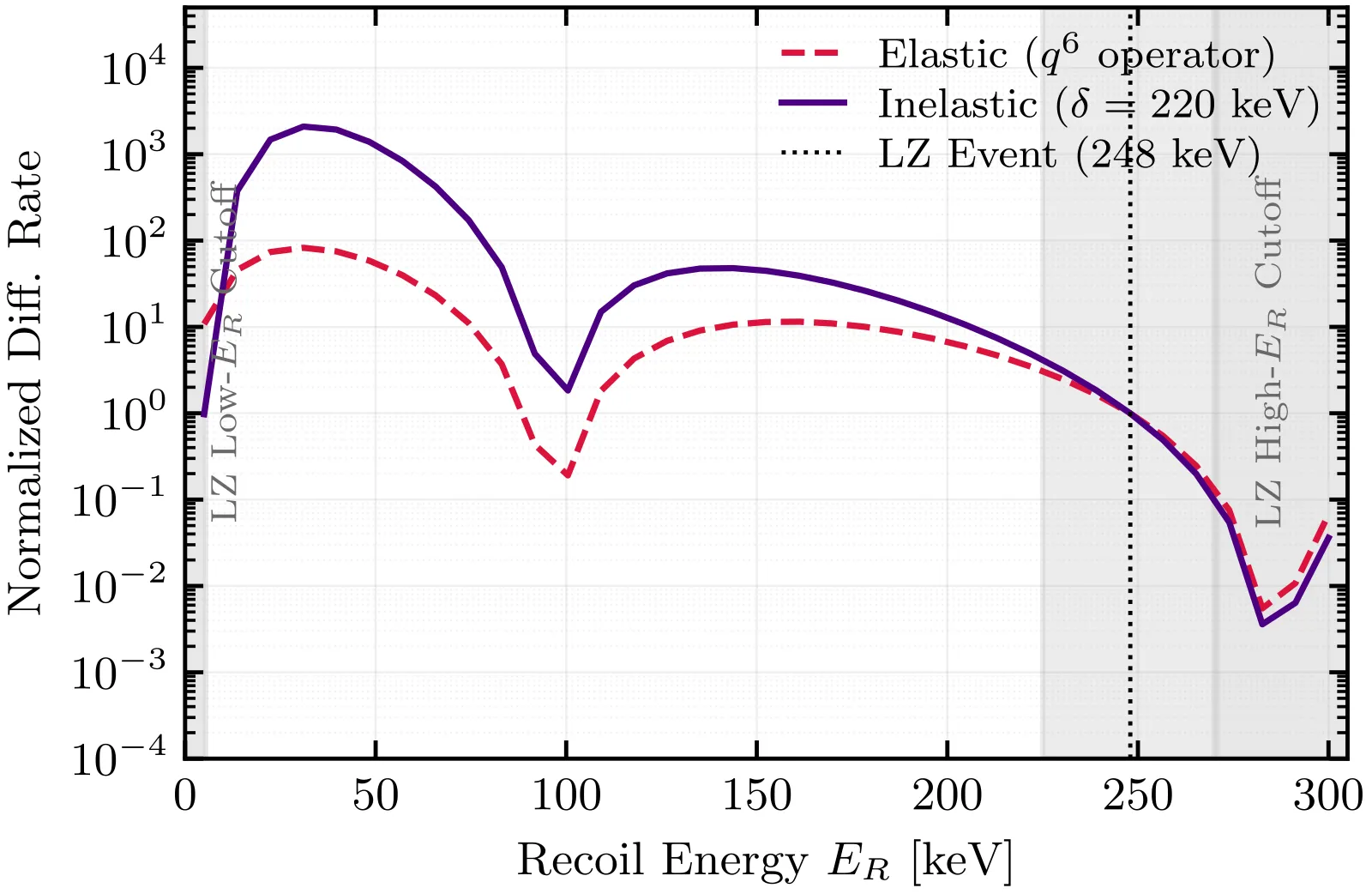
Predicted recoil spectra in xenon: both models produce far more events at low energy (left) than at 248 keV (dotted line). — Figure 1, Kalita (2026), arXiv:2609.29462.
The author tried the two standard escape routes:
- Collisions that grow stronger with the momentum transferred. Even the most extreme version leaves a bump of events around 20–30 keV, about 100 times higher than the rate at 248 keV.
- Particles that change into a slightly heavier state when they hit. This trick works for slow dark matter. But for particles this fast, the small energy cost is negligible: the low-energy excess stays over 1,000 times larger than the signal.
His conclusion is a strict “no-go”: the LZ event cannot come from dark matter emitted by evaporating primordial black holes.
A failure that still teaches
Turned around, the argument becomes a measurement. Since LZ saw no flood of low-energy events, such black holes cannot be common. For black holes of about 2 × 10¹¹ grams, they can make up at most about a millionth of all dark matter (90% confidence). The limit loosens quickly above 10¹³ grams, where the black holes are too cold to matter.
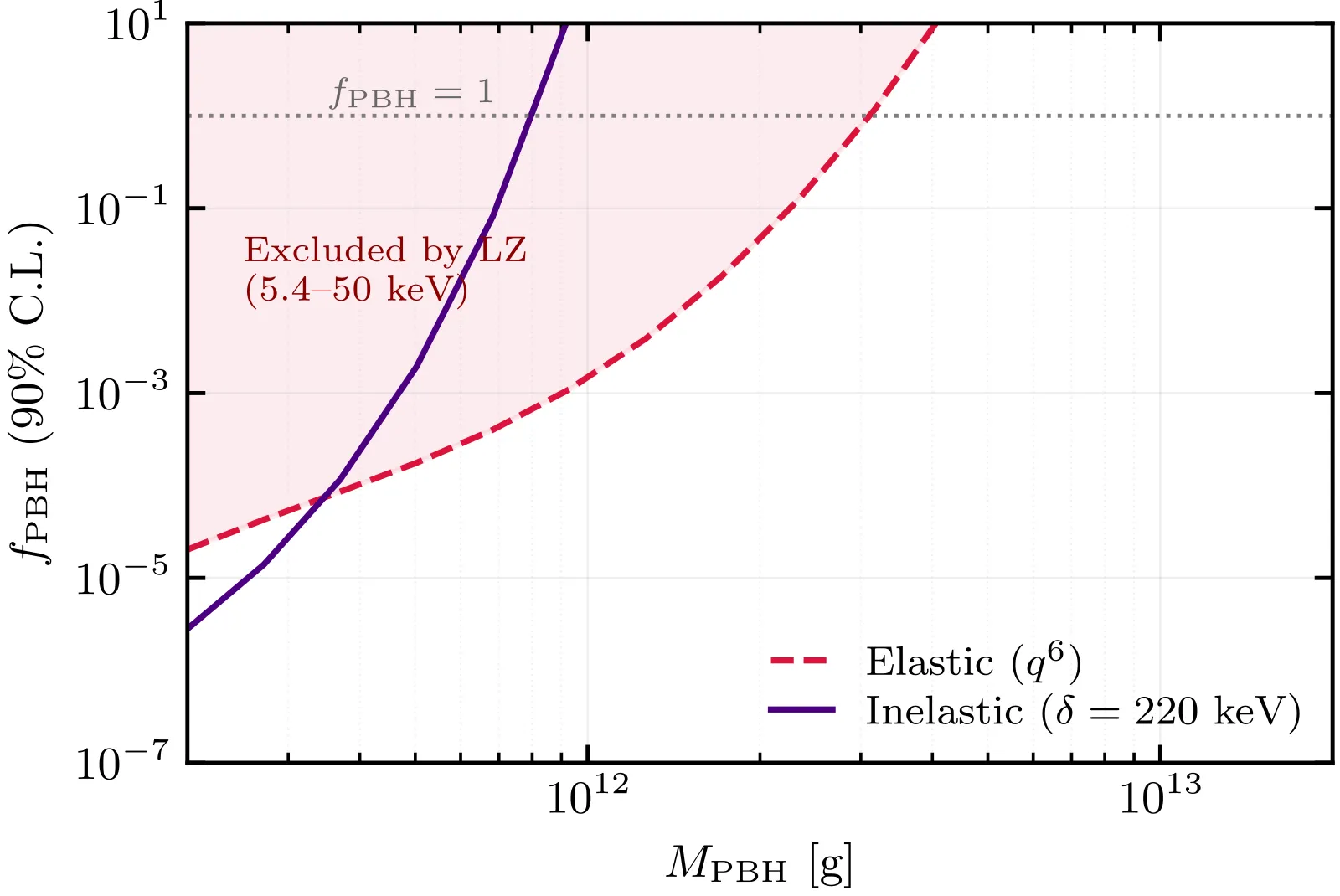
Upper limits on the share of dark matter made of primordial black holes, as a function of their mass: the shaded region is excluded. — Figure 2, Kalita (2026), arXiv:2609.29462.
According to the author, detectors built to catch slow dark matter can thus also probe the fast particles that evaporating black holes would emit.
What remains open
This is a theoretical study by a single author, about one event. The real origin of the LZ hit remains unknown: the paper rules out one explanation, it does not propose another.