Belum diterjemahkan: versi asli berbahasa Inggris.
A CROWDED CRYSTAL THAT STAYS QUANTUM
A quantum sensor measures a magnetic field, a temperature or a pressure by watching how it disturbs a quantum state. Many use spins — tiny quantum magnets — that can be read with light. With N independent spins, the ideal sensitivity improves like the square root of N: the more spins you pack into a volume, the better.
The crowding problem
In practice, packing spins together makes them interact. Their resonances blur and their coherence — the time during which the quantum state stays usable — collapses. The most mature platform, nitrogen-vacancy (NV) centres in diamond, is therefore usually used at only a few to a few tens of parts per million.
Molecules offer another route. Pentacene, an organic molecule made of five rings, can be lit into a “triplet” state whose spin becomes polarised and can be read optically, even at room temperature. But concentrated pentacene suffers from parasitic processes that destroy these triplets. The usual fix is to dilute it in a host crystal — at the cost of density.
The idea: let the crystal do the spacing
A team led by Ashok Ajoy (University of California, Berkeley, and Lawrence Berkeley National Laboratory) and Riccardo Montis (University of Urbino, Italy) studied a co-crystal: two molecules of 6,13-dihydropentacene for one of pentacene. The crystal lattice places each pentacene at a precise position and orientation, surrounded by its partner molecule.
They grew the crystals as pink needles, about 96 micrometres wide, by heating pentacene to 330 °C under argon.
The numbers
- Pentacene makes up one third of the molecules: 333,333 parts per million, or 9.51 × 10²⁰ sites per cubic centimetre — more than 100 times the density of the reference systems (NV diamond, and pentacene diluted in p-terphenyl).
- Neighbouring pentacenes sit as close as 4.10 ångströms, compared with about 72 in the diluted reference.
- The triplets form by the “good” route (intersystem crossing), with strong spin polarisation.
- At room temperature, the team detected the magnetic resonance optically and controlled the spins: Rabi oscillations at 9.2 MHz, and a coherence time of 0.874 microseconds, stretched to 1.6 microseconds with a pulse sequence — the same order of magnitude as the diluted reference (2.7 µs).
- A first, unoptimised estimate of magnetic sensitivity: 157 nanotesla per square root of hertz.
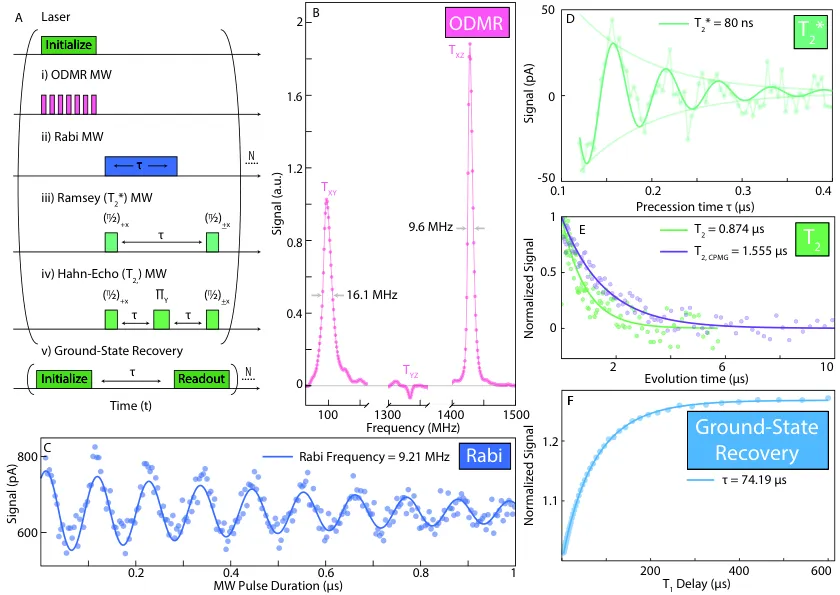
Room-temperature measurements: optically detected resonance, Rabi oscillations and coherence times. — Figure 3, D’Souza et al. (2026), arXiv:2609.28912.
On a plot of coherence against concentration, the crystal sits above the trend extrapolated for diamond.
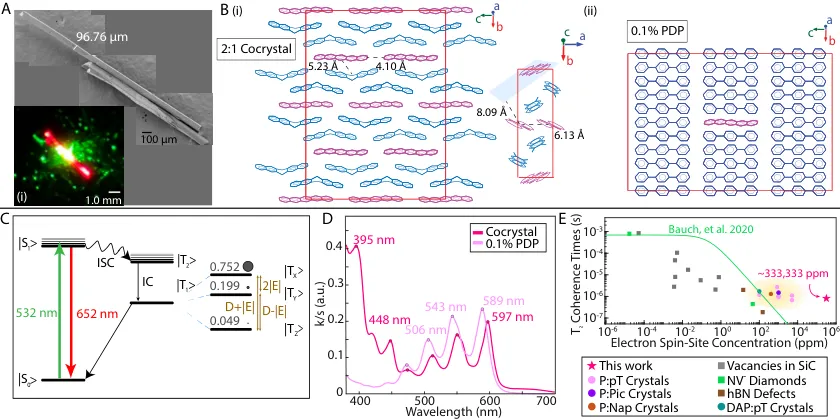
The pink needles, their crystal structure and (E) coherence time versus spin concentration: the crystal sits far to the right of other systems. — Figure 1, D’Souza et al. (2026), arXiv:2609.28912.
Why it survives
According to the team’s calculations, the natural orientation of neighbouring pentacenes sits near a minimum of electronic coupling between them. And the partner molecule’s triplet energy is far higher — a barrier of about 2.2 electronvolts — so the excitation cannot hop from molecule to molecule.
What’s next
The authors see co-crystallisation as a design strategy: the lattice fixes the density, the orientation cuts the couplings. Next steps include a small library of pentacene co-crystals and needles embedded in resonators for magnetometry or thermometry.
Limits
The sensitivity is not optimised yet: higher laser power risked heating and damaging the crystal. The coherence is shorter and the lines broader than in the best diluted systems. And, as the authors note, the concentration of molecular sites is not the same as the number of active triplet spins at any moment.