Belum diterjemahkan: versi asli berbahasa Inggris.
100 MILLION PHOTONS A SECOND FROM ONE MOLECULE
Quantum communication, quantum networks and optical quantum computers all rely on the same basic part: a single-photon source, a device that emits light one photon at a time, on demand, with every photon identical to the next.
Many candidates exist: single atoms, trapped ions, semiconductor quantum dots — the most mature — and defects in diamond or silicon. Organic molecules are a different route. Their structure is set by chemistry, atom by atom, and is exactly reproducible; their colour can be chosen by designing the molecule. They are tiny and cheap to make. Cooled close to absolute zero inside a host crystal, they emit light of the highest possible spectral purity and practically never wear out.
The problem: losing the light
An emitter sends light in all directions, and much of it stays trapped inside the material by total internal reflection. A photon that misses the first lens is gone for good. The usual fixes — microcavities, nanowires — require etching the material. That is impossible here: the organic crystals that give the best light are fragile and do not survive the fabrication processes.
A mirror, a dome and a 140-nanometre layer
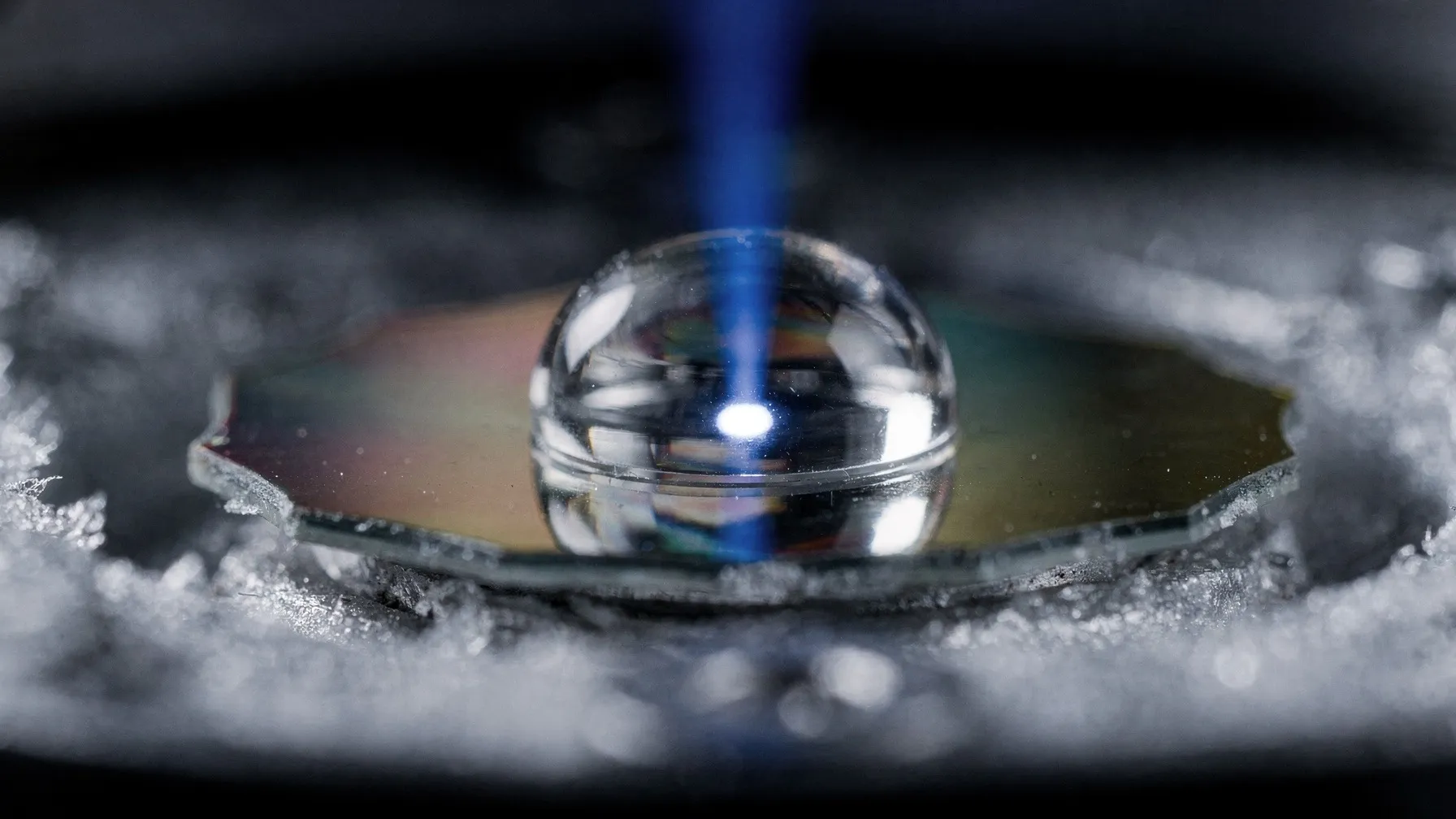
The team of Stephan Götzinger at the Max Planck Institute for the Science of Light in Erlangen used a planar antenna instead. A silver mirror sits under a layer of silica. On top, a hemisphere of zirconium oxide — a “solid immersion lens” — is bonded directly to the substrate, leaving a channel just 140 nanometres thick. That channel is filled with a molten organic crystal (1,4-dichlorobenzene) containing a few molecules of dibenzoterrylene, which then solidifies.
The light is steered towards the high-index dome; the mirror sends back what would escape the other way. Crucially, the crystal itself is never etched: all the structuring is in the substrate. The antenna does not rely on a narrow resonance, so it works over a broad range of colours and hardly depends on how the molecule is oriented. The sample is cooled to 1.4 kelvin (−271.75 °C).
The numbers
- Collection efficiency: 97 ± 2 % of the light reaches the first lens.
- About 100 million photons per second collected from one molecule over its full spectrum — according to the authors, the highest rate reported for any cryogenic single-photon source, whatever the platform. The detected rate, 21.3 million counts per second, is ten times higher than previous cryogenic molecular sources.
- Purity: above 97.5 % — the photons really do come out one at a time, even under strong excitation.
- Indistinguishability: 91.2 ± 2.3 % — how identical successive photons are, limited by a small residual loss of coherence.
- Two photons emitted 170.7 nanoseconds apart still interfere with high visibility.
- As a by-product, the team measured that the molecule converts about 90 % of its excitations into light — the first direct low-temperature estimate for this molecule.
Organic molecules join the race
The results place organic molecules among the competitive platforms for single photons: bright, pure and coherent at once. Because the antenna does not need to be tuned to a particular molecule, the authors expect it to work with other molecule–crystal pairs, and therefore at other colours. Their next goal: tune several neighbouring molecules to the same frequency to produce more complex quantum states of light — a step towards future quantum photonic networks.