
CLOUDS WITHOUT FLUID MECHANICS
Nobody would model the water in a pipe by tracking every molecule: the laws of fluid mechanics do the same job “on a laptop instead of a datacenter”. But Earth’s atmosphere is such a complex fluid that even those laws need a datacenter again. That is the starting point of Thomas DeWitt’s doctoral thesis, submitted to the University of Utah’s Department of Atmospheric Sciences under Timothy Garrett.
The numbers are daunting. For a weather model to be numerically exact, its grid would have to reach scales of about a millimetre, where swirling motions finally die out. Today’s most advanced kilometre-scale models resolve less than half of the range of scales involved. A next-generation climate model must still approximate some 10¹⁸ millimetre-scale circulations inside each grid box. Storing the temperature field of the lower atmosphere at a single instant would take about 10²⁹ bytes. And despite ever finer models, the spread between them on climate sensitivity has not shrunk in 40 years, the thesis notes.
Looking for laws one level up
DeWitt’s question: are there emergent laws for weather and climate, just as fluid mechanics emerges from countless molecules? His answer starts from a symmetry, scale invariance: within a wide range, the atmosphere at one scale looks like a stretched version of itself at another.
The first chapters, two of them already published in the journal Atmospheric Chemistry and Physics, argue that this symmetry has often been hidden by measurement artefacts. Clouds cut off by the edge of a satellite image can create a fake size limit and bias measurements by 20 to 30%. Holes in clouds distort the usual way of measuring their fractal shape. And wind measurements from weather balloons and dropsondes do not show the expected changes of regime with scale: they fit a single, stretched “anisotropic” turbulence proposed by Shaun Lovejoy and Daniel Schertzer.
The turbulon
The fifth chapter turns this into a model. Its building block is the turbulon: a precise mathematical version of the “eddy” of classical turbulence theory. A turbulon is a bundle of localised bumps of the same shape in every atmospheric field — temperature, humidity, energy — each with its own strength. The bigger a turbulon, the flatter it is, following the stretched turbulence law. A cloud field is then nothing but a pile of countless turbulons of all sizes.
The Superposition of Turbulons and Eddies Atmospheric Model, STEAM, works from the largest turbulons down to the smallest, adding perturbations at each size. Then it works out where water condenses into cloud. It never solves the Navier-Stokes equations, and it has no time steps. As input, it only needs average vertical profiles of moisture and energy, plus a few constants.

A field of cumulus clouds simulated by STEAM and rendered by ray-marching. — Figure 5.1, DeWitt (2026), arXiv:2609.30589.
How close to the real thing?
DeWitt compared 330 STEAM simulations with very-high-resolution simulations of two tropical field campaigns — each with more than a billion grid points — and with nine models from an international comparison project. Often, the gaps between STEAM and a reference model were about as large as the gaps between two reference models. Yet the flaws are clear: two to five times too much low cloud, too much temperature variability near the ground, and a spurious peak of variability near the tropopause, where STEAM reads the sharp change in the average profile but not its direction. Without rain in the model, cloud water also piles up too high in dense cores.
The surprise comes from space. Compared with 72 satellite images, the geometry of STEAM’s clouds — how jagged their edges are, how sizes are distributed — matched the observations as well as or better than the reference simulations, for one setting of the model. Some of STEAM’s disagreements, the author suggests, might reveal weaknesses in the reference models.
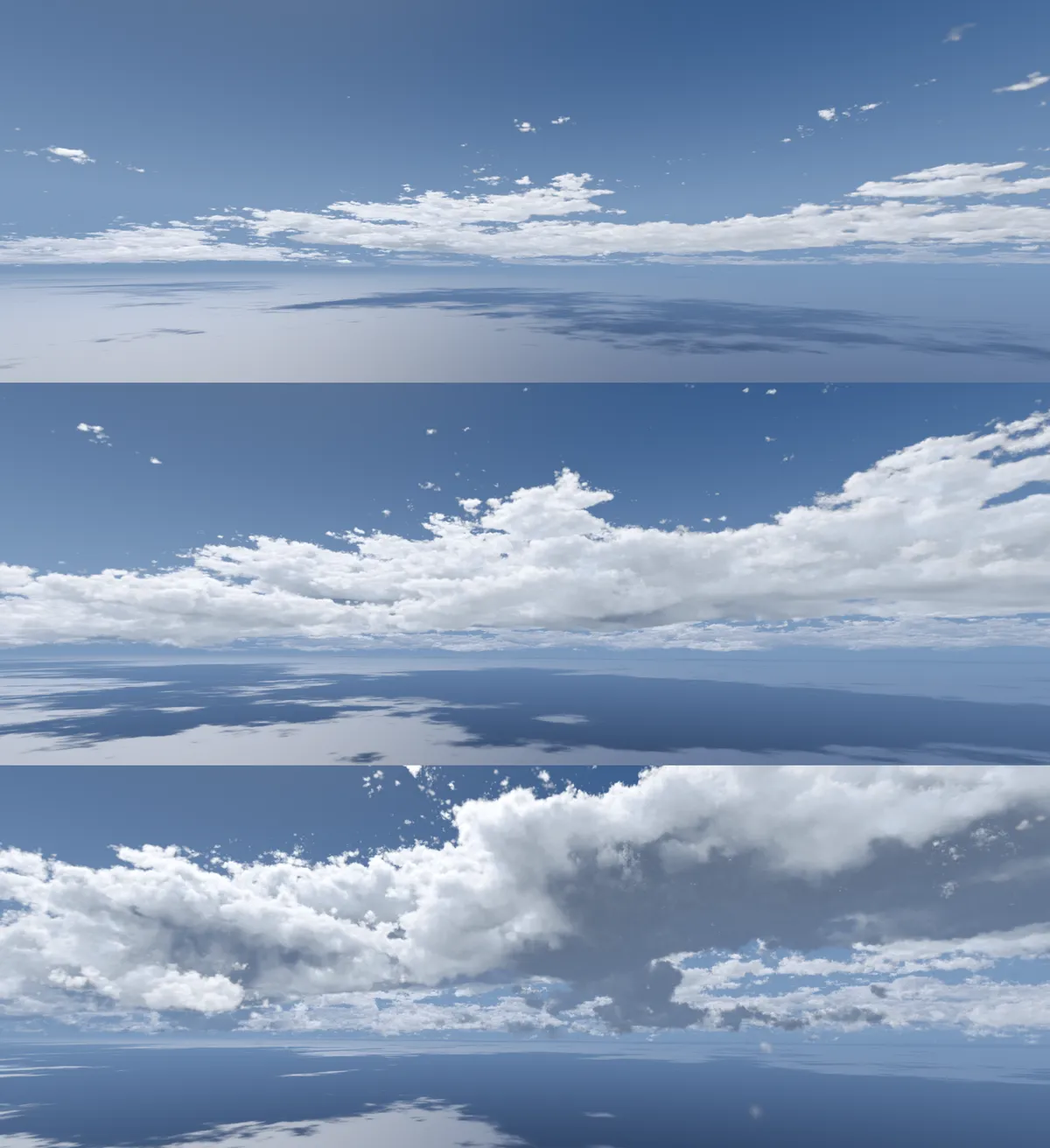
The same simulation with the scale at which turbulons are round set to 10, 30 and 100 metres: from thin scattered cumulus to towering cumulus congestus. — Figure 5.12, DeWitt (2026), arXiv:2609.30589.
A million times cheaper — with conditions
On a desktop computer, the reference model CM1 needs about 29 days of computing for a 100-day simulation. A matched STEAM field takes 1.7 seconds. Because STEAM produces each independent snapshot directly, without spin-up, DeWitt estimates it is 100,000 to a million times cheaper per snapshot.
The catch is spelled out in the thesis itself. STEAM does not predict its own average state: it borrows it from another model. Its “roundness” scale is fixed for a whole simulation, so deep storms and thin high clouds never share a volume. And because it has no time, it cannot forecast tomorrow’s weather — its strength is statistics. The thesis concludes that the Navier-Stokes equations “may not, in fact, be required” for simulating weather and climate; for now, that remains a proposal waiting to be built upon.